
 Hotel Owners / Asset Managers
 Revenue Managers
 Revenue Management Consultants
 Management Companies
 Hotel Brands
 Independent Hotels
 Economy and Budget Hotels
 Integration Partners
 Blog
Blog FAQ’s
FAQ’s Case Studies
 Events
According to the latest PwC US Hospitality Directions report, the U.S. lodging industry has entered a period of significant recalibration. After years of post-pandemic volatility, RevPAR (Revenue Per Available Room) growth is projected to stabilize at a modest 1.5% for 2025, driven almost entirely by marginal gains in Average Daily Rate (ADR) rather than occupancy.
This trajectory tells a clear story: the “easy” growth of the recovery era is over. For hotel owners, revenue managers, and management companies, this kind of softening is exactly when data discipline separates properties that protect their margins from those that quietly bleed them. As demand patterns remain inconsistent and operating costs continue to rise, the operators who respond effectively are the ones who know which numbers to watch and what those numbers are actually telling them.
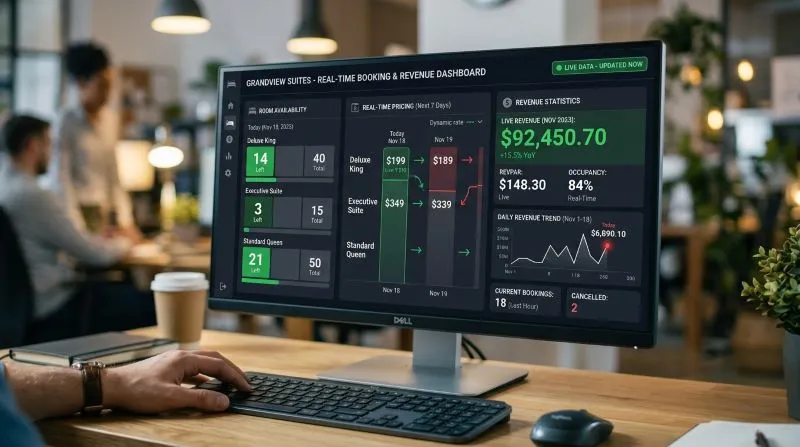
Hotel performance metrics are quantifiable measures used to evaluate a property’s financial health, operational efficiency, and competitive position. A well-tracked set of hotel key performance metrics does more than report history; it reveals where revenue is leaking, which segments are underperforming, and where pricing decisions need to be recalibrated.
This article covers the 10 most important indicators, how to calculate them, why they matter, and how to use them to drive better decisions, not just better reports.
What Are Hotel Performance Metrics and Why Do They Matter?
Hotel performance metrics are the foundation of revenue management. Without them, pricing decisions are guesswork, staffing levels are reactive, and profitability is harder to defend in owner conversations or board reviews.
The right hotel industry performance metrics give operators a shared language across departments. Sales, operations, and finance can align around the same targets, spot the same problems, and course-correct faster. That alignment becomes especially valuable during periods of demand softness or rising costs, which, based on current trends, describes a significant portion of the market heading into 2026.
Beyond internal planning, these metrics also determine how a property is perceived by investors and lenders. A hotel with clean, consistently tracked KPIs tells a more compelling story than one relying on intuition. That credibility matters when refinancing, negotiating management contracts, or benchmarking against a comp set.
The bottom line: what gets measured gets managed, and what gets managed gets improved.
Quick Reference: The 10 Hotel Performance Metrics at a Glance
| Metric | Formula | Primary Use | Review Frequency |
| ADR | Room Revenue / Rooms Sold | Pricing performance | Daily |
| RevPAR | ADR × Occupancy Rate | Revenue efficiency | Daily |
| Occupancy Rate | Rooms Sold / Rooms Available × 100 | Demand tracking | Daily |
| GOPPAR | Gross Operating Profit / Available Rooms | Profitability | Monthly |
| CPOR | Total Operating Costs / Occupied Rooms | Cost control | Monthly |
| ALOS | Occupied Room Nights / Reservations | Stay pattern analysis | Weekly |
| CSAT / CSS | Guest survey & review scores | Satisfaction & loyalty | Weekly |
| MPI | Your Occupancy / Comp Set Occupancy × 100 | Competitive position | Weekly |
| RGI | Your RevPAR / Comp Set RevPAR × 100 | Revenue vs. market | Weekly |
| Channel Performance | Revenue by booking source | Distribution mix | Monthly |
The 10 Key Hotel Performance Metrics You Should Be Tracking
1. Average Daily Rate (ADR)
ADR is the average revenue earned per occupied room in a given period. The formula is straightforward:
ADR = Total Room Revenue / Number of Rooms Sold.
According to STR and AHLA data, the average U.S. hotel ADR in 2025 sits near $160, a figure that has grown modestly but lagged inflation in many markets. That gap matters: if your rate increases don’t outpace cost growth, real profitability erodes even when ADR looks healthy on paper.
To optimize ADR, move away from flat rate strategies and toward dynamic pricing that adjusts in real time based on demand signals, competitor positioning, and booking window. Practical ADR improvement levers include:
- Dynamic pricing rules tied to booking pace, day of week, and local demand events
- Length-of-stay pricing that offers modest discounts for multi-night stays without eroding peak-night rate
- Room type yield management to ensure premium inventory is not undersold during high-demand periods
- Advance purchase rates that reward early bookers and reduce last-minute discounting
Properties using automated revenue management tools consistently outperform those relying on manual rate setting. Learn how Ramsi’s agentic AI adjusts pricing dynamically.
2. Revenue Per Available Room (RevPAR)
RevPAR is the single most cited hotel revenue performance metric in the industry, and for good reason. It captures both rate and occupancy in one figure:
RevPAR = ADR × Occupancy Rate
(or Total Room Revenue / Total Available Rooms).
The average U.S. hotel RevPAR in 2025 is approximately $102.78, according to data aggregated from STR, AHLA, and CBRE. Properties in high-demand urban markets like New York City run significantly higher; secondary and drive-to markets sit well below that figure. Context is everything.
RevPAR is useful for trend analysis and comp-set benchmarking, but it has a real limitation: it says nothing about cost. A property with strong RevPAR and bloated operating expenses can still post a disappointing bottom line.
3. Occupancy Rate
Occupancy Rate = Rooms Sold / Rooms Available × 100.
It measures what percentage of your inventory was actually sold during a given period.
The national average in 2025 sits near 63.4%, per STR data. North American markets averaged 67.5% in 2024, though that figure varies dramatically by season, location, and segment. Luxury and resort properties in top markets regularly exceed 70-75% occupancy; budget properties in oversupplied markets often fall short of 55%.
Occupancy alone can mislead. A 90% occupancy rate achieved by discounting deeply may generate less net revenue than 75% at a higher rate. That’s why occupancy should always be analyzed alongside ADR, never in isolation.
4. Gross Operating Profit Per Available Room (GOPPAR)
GOPPAR is where hotel performance analysis gets serious. Unlike RevPAR, which focuses only on room revenue, GOPPAR accounts for all operating revenue and expenses.
GOPPAR = Gross Operating Profit / Total Available Rooms
This is the metric that hotel investors and asset managers care about most, because it reflects actual profitability. A property can show a healthy RevPAR while its GOPPAR is declining, a warning sign that costs are growing faster than revenue.
According to Q3 2025 performance data from HotelData.com, GOP margins are tracking roughly two and a half points below 2025 budget projections, driven by rising labor costs, utility inflation, and slower-than-expected food and beverage recovery. Tracking GOPPAR monthly gives operators an early warning before these pressures become a full-margin problem.
5. Cost Per Occupied Room (CPOR)
CPOR = Total Operating Costs / Number of Occupied Rooms.
It tells you precisely what it costs to service each guest night, covering housekeeping, amenities, front desk labor, and related expenses.
CPOR is one of the hotel key performance metrics most often overlooked by operators focused on revenue. But in a margin-compressed environment, understanding your cost per room is just as important as understanding your rate per room. A $10 reduction in CPOR across 200 rooms, 300 days a year, adds $600,000 to the bottom line.
Common levers include streamlining housekeeping schedules based on actual checkout patterns, reducing single-use amenity waste, and cross-training staff to improve scheduling flexibility.
6. Average Length of Stay (ALOS)
ALOS = Total Occupied Room Nights / Number of Reservations.
Longer stays mean lower turnover costs, fewer check-in/check-out transactions, and more stable demand forecasting.
A guest staying four nights instead of two doesn’t just double revenue; it reduces the operational overhead associated with room turnovers, reduces the risk of a night going unsold between reservations, and often signals higher satisfaction with the property.
Effective ways to improve ALOS without a discount rate:
- Set minimum-stay restrictions (2-3 nights) during peak demand and event weekends
- Offer stay-longer packages that bundle extras: dining credits, late checkout, parking, or spa access
- Target leisure travelers in shoulder seasons with “extended escape” promotions
- Use booking engine logic to nudge guests toward longer stays at the time of reservation
7. Customer Satisfaction Score (CSAT / CSS)
Guest satisfaction scores, typically sourced from post-stay surveys and OTA reviews, are among the most undervalued hotel performance indicators. They directly influence future demand: properties with higher review scores command higher rates and convert browsers into bookers at higher rates on OTA platforms.
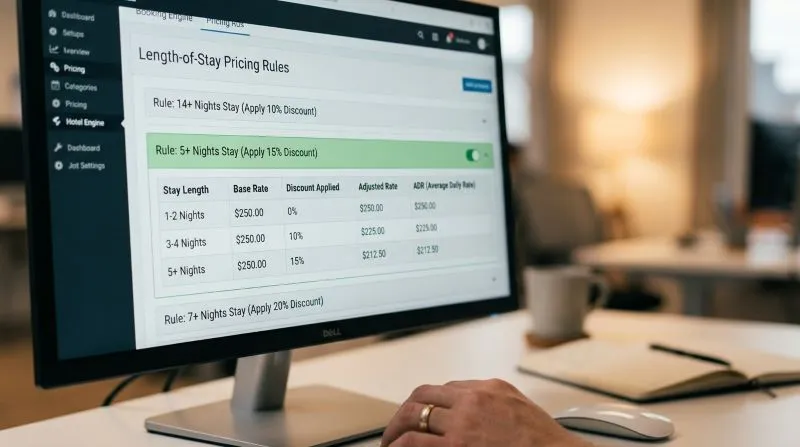
A one-point increase in a hotel’s review score on a major OTA platform can allow a property to increase its rate by 11% while maintaining the same occupancy, according to research published by Cornell’s Center for Hospitality Research. That is a direct revenue impact from a non-financial metric.
Tracking CSAT by department (front desk, housekeeping, F&B, maintenance) lets management address problems at the source rather than managing the overall score reactively.
8. Market Penetration Index (MPI)
MPI compares your occupancy rate to your competitive set:
MPI = Your Occupancy Rate / Comp Set Average Occupancy Rate × 100
A score above 100 means your property is capturing more than its fair share of available demand.
MPI is one of the three STR index metrics (alongside ADI and RGI) and is particularly useful for identifying where your sales and marketing strategy is outperforming (or underperforming) the market. An MPI below 100 during peak demand periods is a signal worth investigating: it may point to rate positioning that’s driving guests to competitors, or distribution gaps that are limiting visibility.
9. Revenue Generation Index (RGI)
RGI = Your RevPAR / Comp Set Average RevPAR × 100.
An RGI above 100 indicates your property is generating more revenue per available room than the competitive average.
RGI is the most complete picture of competitive revenue performance because it rolls both rate and occupancy into a single comparison. It is one of the most important hotel industry performance metrics for management companies and asset managers benchmarking a portfolio of properties.
Consistently low RGI in a market where competitors are performing well typically signals a pricing, distribution, or positioning issue, and provides the clearest case for a strategic reset.
10. Distribution Channel Performance
This metric tracks what percentage of bookings and revenue comes from each channel: direct website, OTA (Booking.com, Expedia), GDS, voice, and others. The goal is not just volume, but profitability by channel.
OTA bookings typically carry commission costs of 15-25%, while direct bookings cost a fraction of that. With 66% of millennials now preferring to book directly through hotel websites and apps (SiteMinder, 2025), properties that invest in direct booking engines and loyalty programs are finding real margin improvement, not just gross revenue gains.
Tracking distribution channel performance monthly lets revenue managers reallocate marketing spend toward lower-cost, higher-margin channels and reduce OTA dependency over time.
How to Analyze and Use These Hotel Performance Metrics Effectively
Tracking is only half the work. The other half is knowing what to do with the data.

Here is a practical framework for putting these metrics to work:
- Establish a reporting cadence. Review occupancy, ADR, and booking pace daily. Analyze channel mix and CSAT trends weekly. Reserve GOPPAR, CPOR, and competitive index reviews for monthly sessions. Without a fixed rhythm, metrics become historical artifacts rather than decision-making tools.
- Segment before you conclude. Aggregate numbers mask variation. Break RevPAR down by room type, market segment (transient leisure, corporate, group), and booking window. A healthy overall average can hide a deteriorating corporate segment or a struggling room category.
- Set variance thresholds. Define the range within which each metric is acceptable. Anything outside that range (above or below) triggers a review, not just a notation.
- Connect metrics across departments. CSAT trends connect to occupancy. CPOR connects to GOPPAR. When these relationships are visible on a single dashboard, the causes behind the numbers become much easier to identify and address.
- Automate where possible. Manual reporting introduces delay and error. Real-time data feeds from your PMS, channel manager, and review platforms give you the ability to respond to market shifts in hours, not weeks.
See how Ramsi’s AI-powered platform centralizes hotel performance data in a single revenue management workflow.
What Are the Risks of Tracking Metrics Incorrectly?
How Focusing on the Wrong Metrics Leads to Bad Decisions
The most common mistake is optimizing a single metric in isolation. A revenue manager laser-focused on occupancy might accept deeply discounted rates during soft demand periods, filling rooms at a cost that damages ADR, erodes rate positioning with OTA algorithms, and trains guests to wait for deals. The property looks full. The P&L tells a different story.
Similarly, over-indexing on RevPAR without watching GOPPAR can mask a profitability problem until it’s embedded in the cost structure. Rate growth and cost growth need to be tracked together, not separately.
Other patterns that consistently cause problems:
- Comparing to the wrong benchmark. Measuring your occupancy against a national average when your comp set is outperforming that average gives a false sense of security.
- Ignoring booking window data. If your on-the-books pace for next month is 20% behind the same point last year, that is a revenue problem forming right now, not next month.
- Treating CSAT as a soft metric. Guest satisfaction scores directly affect OTA ranking algorithms and rate conversion. Dismissing them as qualitative misses a quantifiable revenue impact.
- Reviewing metrics only monthly. In fast-moving demand environments, monthly reviews mean you are always reacting to history rather than shaping current outcomes.
The Danger of Stale Data in a Fast-Moving Market
Hotel markets move quickly. A pricing decision made on last month’s comp set data, or worse, last quarter’s, may already be misaligned with current demand patterns. Properties that review their metrics infrequently are essentially flying on a delayed radar.
The 2025 budget cycle is a clear example: according to HotelData.com, rooms revenue finished 13.2% below budget in Q3 2025 for many properties. Early budget forecasts assumed demand levels that didn’t materialize. Properties that updated their forecasts frequently, and adjusted pricing accordingly, narrowed the gap significantly compared to those holding to original plans.

Automation and real-time data feeds are the practical solution. Relying on manual spreadsheet updates creates both delay and error risk in data that is already time-sensitive.
Stay Competitive by Tracking Key Hotel Performance Metrics
The hotels that protect margin in a slow-growth market are not the ones with the best instincts; they are the ones with the best data.
Tracking these 10 hotel performance metrics consistently gives owners, revenue managers, and management companies the visibility to make faster, more confident decisions. The difference between a property that reacts to market shifts and one that anticipates them often comes down to whether the right numbers are on the desk at the right time.
The metrics themselves are not complicated. Building a system that tracks them automatically, surfaces anomalies in real time, and connects them to pricing actions is where the real competitive advantage lives.
Ready to put your hotel’s performance data to work? Book a free revenue audit with Ramsi and see how agentic AI can track, analyze, and act on your key metrics automatically.
Frequently Asked Questions
What is the most important hotel performance metric?
There is no single answer, but RevPAR and GOPPAR together give the most complete picture of performance. RevPAR captures room revenue efficiency; GOPPAR reflects what actually hits the bottom line after operating costs. Tracking one without the other leaves a significant blind spot.
How often should hotel performance metrics be tracked?
Core metrics like occupancy rate and ADR should be reviewed daily. Competitive indices (MPI, RGI), channel mix, and CSAT scores work well on a weekly cycle. GOPPAR and CPOR are most meaningful as monthly reviews, with quarterly benchmarking against your comp set.
Can hotel performance metrics be tracked manually?
Technically, yes, but at a real cost. Manual tracking introduces errors, delays, and limits how quickly you can respond to market shifts. For independent hotels or smaller properties with limited staff, even a basic PMS with automated reporting dramatically outperforms a spreadsheet-based approach.
What is the difference between RevPAR and ADR?
ADR measures only the average rate per occupied room, so it reflects pricing performance. RevPAR divides total room revenue by all available rooms (occupied or not), so it captures both pricing and occupancy. A property with high ADR but low occupancy can have lower RevPAR than a property with a more moderate rate and fuller house.
How can hotel managers increase occupancy without reducing prices?
Focus on market segmentation, booking window optimization, and distribution mix rather than rate cuts. Targeting underserved segments (groups, long-stay corporate travelers, domestic leisure), reducing minimum stay restrictions during soft periods, improving OTA listing quality, and investing in direct booking channels can all drive occupancy without sacrificing rate integrity.