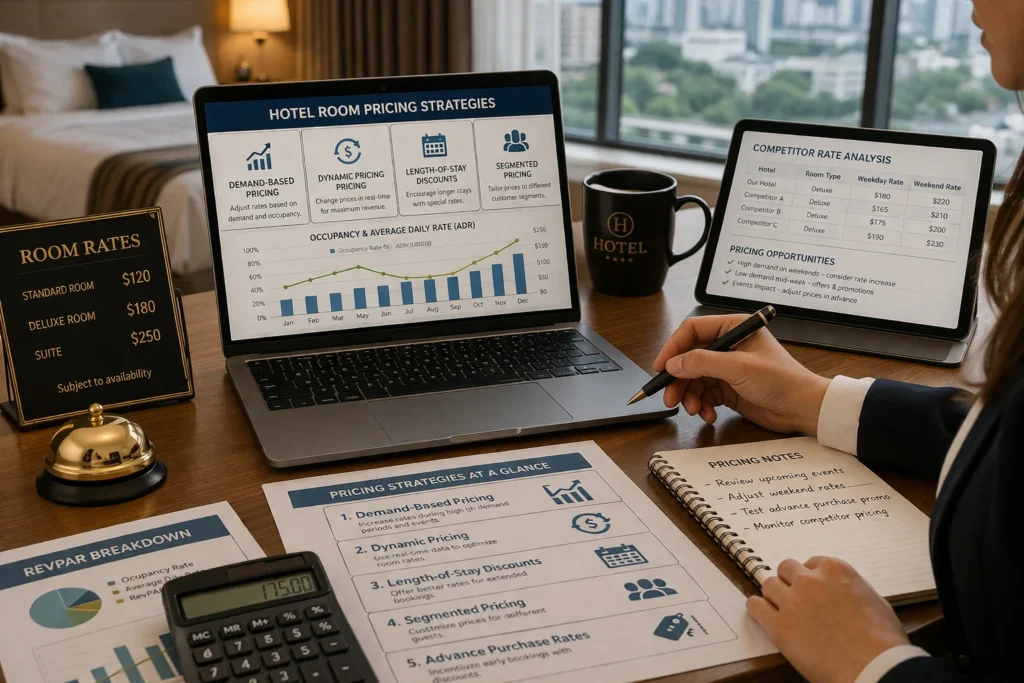
A hotel room is a perishable asset. The night a room goes unsold, that revenue is gone forever — there’s no restocking it the next day. That reality makes hotel room pricing strategies one of the most consequential decisions a property makes, not just for daily revenue, but for long-term competitiveness, occupancy stability, and how guests perceive value.
Pricing directly shapes all three. Set rates too high for the demand level and rooms sit empty; price too low for too long, and RevPAR erodes even when occupancy looks healthy. The properties that get this balance right consistently — adjusting to market signals, planning around demand cycles, and building value into every offer — outperform competitors not just in revenue, but in guest trust and repeat business.
The five strategies below are the operational frameworks that experienced revenue managers and ownership groups use to price with confidence across market conditions.
Strategy #1: Dynamic Pricing for Hotel Rooms
Dynamic pricing adjusts room rates in real time based on demand signals, competitive positioning, booking pace, and market conditions. When demand is strong — a sold-out citywide event, a holiday weekend, a competitor showing low availability — rates rise to capture maximum revenue. When occupancy is lagging, rates ease to stimulate bookings before the night is lost entirely.
The engine behind dynamic pricing is typically a Revenue Management System (RMS), which pulls live data from competitor feeds, OTA channels, and internal booking curves to recommend or automatically apply rate changes. Without that infrastructure, manual dynamic pricing is slow and impossible to scale consistently across multiple room types and dates.
Situations that call for rate increases:
- Competitor hotels are showing low availability for the same dates
- Local events, concerts, or conferences are approaching
- Booking pace is running ahead of historical averages for the period
Situations that call for rate reductions:
- Occupancy on a given night is well below target, with limited lead time remaining
- Shoulder periods between peak seasons with historically soft demand
- Midweek inventory in leisure-focused destinations
The key discipline here is avoiding the trap of discounting too early. Dropping rates weeks out based on anxiety rather than data erodes RevPAR without meaningfully improving occupancy — one of the most common and costly mistakes in hotel room rate pricing strategy.
Strategy #2: Seasonal and Event-Based Pricing
Seasonality is predictable, and that predictability is an advantage hotels should plan around rather than simply react to. Building a rate structure that accounts for peak, shoulder, and off-peak periods in advance gives revenue teams a foundation to work from — rather than scrambling to respond when demand has already shifted.
Event-driven pricing takes seasonal logic further. Major conferences, sports events, festivals, and local holidays create demand spikes that hotels can anticipate and price for months ahead. The properties that consistently capture the highest rates during these windows are those monitoring forward-looking booking data and competitor rates systematically — not those that notice a sold-out city and raise rates on the day.
| Period Type | Pricing Approach | Key Data Input |
| Peak Season | Rate premium + minimum stay restrictions | Historical occupancy, year-over-year booking pace |
| Shoulder Season | Moderate rates + value packages | Lead time trends, competitive set rates |
| Off-Peak | Targeted discounts to stimulate demand | Booking curve vs. budget, cost floor |
| Event Windows | Aggressive rate increases are reviewed frequently | Event calendar, competitor rate feeds |
Strategy #3: Length of Stay Pricing Strategy
A length-of-stay (LOS) pricing strategy adjusts rates based on how many nights a guest books. The most common application is offering a per-night discount for extended stays — typically three nights or more — in exchange for filling what would otherwise be harder-to-sell midweek inventory.
The logic is straightforward: a guest staying five nights at a modest discount is almost always more profitable than two separate short stays, given the reduced housekeeping turnover, check-in/check-out processing costs, and channel fees on multiple transactions.
LOS strategies should be calibrated by segment rather than applied as a blanket policy — business travelers tend to book shorter stays than leisure guests, so the thresholds and minimum night requirements that make sense for a city-center business hotel differ significantly from a resort.
Strategy #4: Advanced Purchase and Early Bird Discounts
Early booking discounts create a genuine exchange of value: guests who plan ahead receive a lower rate, and hotels secure committed occupancy weeks or months out, which improves forecast accuracy and cash flow management. The real benefit for the property isn’t just filling rooms sooner — it’s the visibility that forward bookings create for all subsequent pricing decisions on remaining inventory.
Guests are now averaging booking 32 days in advance, and cancellations are falling below 20%, according to HospitalityNet. When guests are already planning further ahead, rewarding that behavior with preferred rates converts hesitant browsers into committed bookings before the high-demand period even begins.
A few structural rules make this strategy work properly:
- Non-refundable rates: Pairing early bird discounts with non-refundable terms reduces cancellation exposure significantly
- Clear discount thresholds: Typically 10–20% off the best available rate for bookings made 21–60 days out
- Inventory caps: Limiting the number of discounted rooms prevents selling the entire house below market before demand peaks
Hotel owners and asset managers often find this strategy particularly effective for new property launches or post-renovation periods, when building forward occupancy quickly is the primary goal.
Strategy #5: Value-Added Bundling and Upselling
Rate discounts are one way to attract bookings — bundling is a smarter one. Instead of lowering the room rate, bundled packages add perceived value by combining the room with ancillary services: breakfast, parking, spa access, airport transfers, or dining credits. The guest pays more in total but perceives a better deal because the bundle price is lower than buying each element separately.
This approach protects the average daily rate while still moving inventory — and it shifts the pricing conversation away from “how cheap can I get a room?” toward “what’s included?” The commercial case is clear: direct bookings generated an average of $519 per booking compared to $320 via OTAs in 2024, according to PhocusWire, and bundled packages on direct channels are a key driver of that gap.
Independent hotels often find bundling particularly effective because it creates differentiation that OTAs can’t easily commoditize. A package built around local experiences — a curated food tour, a guided city walk — is something a chain can’t easily replicate, and it commands a premium that pure room-rate competition never could.

Using Technology to Implement Hotel Room Pricing Strategies Effectively
Revenue Management Systems and Their Role in Pricing
An RMS is the operational backbone of any effective hotel room pricing strategy. It integrates with the property’s PMS, channel manager, and OTA connections to centralize rate management — pushing updates across all distribution channels simultaneously rather than requiring manual adjustments per platform. That consistency matters: rate discrepancies between channels confuse guests and can trigger OTA penalties that cost far more than the revenue they were meant to protect.
Modern RMS platforms do more than automate updates. They generate demand forecasts, track competitor rate changes in real time, and surface pricing recommendations based on configurable rules. For revenue management consultants working across multiple properties, a well-integrated RMS with strong reporting and exception alerting is non-negotiable — the volume of decisions required across channels and date ranges simply can’t be managed manually at scale.
Automation Tools and Artificial Intelligence for Pricing Decisions
AI-powered pricing tools extend RMS capabilities by learning from patterns that static rule sets miss. Machine learning models can identify relationships between search traffic trends, lead time behavior, local demand signals, and historical booking data — generating rate recommendations that adapt automatically as conditions change, without requiring manual intervention on every decision.
The practical benefit is speed and consistency. By the time a revenue manager manually reviews data and approves a rate change, the optimal pricing window may have already closed. Automation closes that gap — executing adjustments in real time, across all channels, at a frequency no manual process can match.
Smarter Pricing Starts With the Right Framework
Each of the five strategies here addresses a different dimension of the pricing challenge: dynamic pricing handles real-time market responsiveness; seasonal and event pricing builds a structured rate calendar; LOS pricing optimizes the booking mix; early bird discounts secure forward occupancy; and bundling shifts the value conversation entirely.
Used together, within a technology-supported revenue management framework, they compound — producing a pricing operation that’s difficult for competitors to match and resilient across demand cycles. The hotels that lead in revenue performance over the next decade won’t necessarily have the best locations or the most rooms. They’ll be the ones that treat pricing as a discipline, invest in the tools that support it, and build teams capable of turning data into decisive action.
Ready to put these hotel room pricing strategies to work? Explore how Ramsi’s revenue management solutions give your property the tools, expertise, and competitive intelligence to price with confidence — and turn that precision into measurable, sustainable revenue growth.