
The hospitality industry has reached an inflection point with artificial intelligence. What started as chatbots and basic automation has expanded into a technology layer that touches pricing, operations, guest communication, forecasting, and staff scheduling. For hotels that implement AI thoughtfully, the results are concrete.
According to PhocusWire, properties adopting AI-powered pricing systems are seeing RevPAR gains of up to 15%, with 74.5% of independent operators reporting positive measurable returns from AI adoption.
The momentum behind the best hotel AI software for the hospitality industry is accelerating.
HospitalityNet reports that 82% of hotels are expanding AI use in 2026, with 85% allocating at least 5% of IT budgets to AI tools. The challenge isn’t whether to invest — it’s choosing the right solution for the specific problems a property needs to solve.
Key Benefits of Using AI Software for Hotels
Improved Operational Efficiency and Automation
The most immediate impact of AI software for hotels is time. Tasks that once consumed hours daily — rate updates, booking confirmations, housekeeping scheduling, maintenance reporting — can be automated without sacrificing accuracy. That recovered time redirects toward guest interaction and strategic work that genuinely requires human judgment.
The efficiency gains compound at scale. A property managing rates manually across multiple room types and channels faces exponentially more complexity than one running automated systems. AI handles that complexity without additional headcount.
Optimized Pricing and Revenue Management
AI hotel pricing software processes demand signals that no human team can monitor continuously — competitor rate movements, booking pace, local event calendars, weather forecasts, cancellation patterns. The output is a pricing recommendation, or in fully automated systems, a live rate adjustment, executed in real time across every distribution channel simultaneously.
The revenue management benefit isn’t just about capturing peaks. It’s equally about avoiding unnecessary discounting during periods where demand would have supported a higher rate — a pattern that erodes ADR quietly and is rarely visible until a full-year RevPAR review.
Enhanced Guest Experience and Personalization
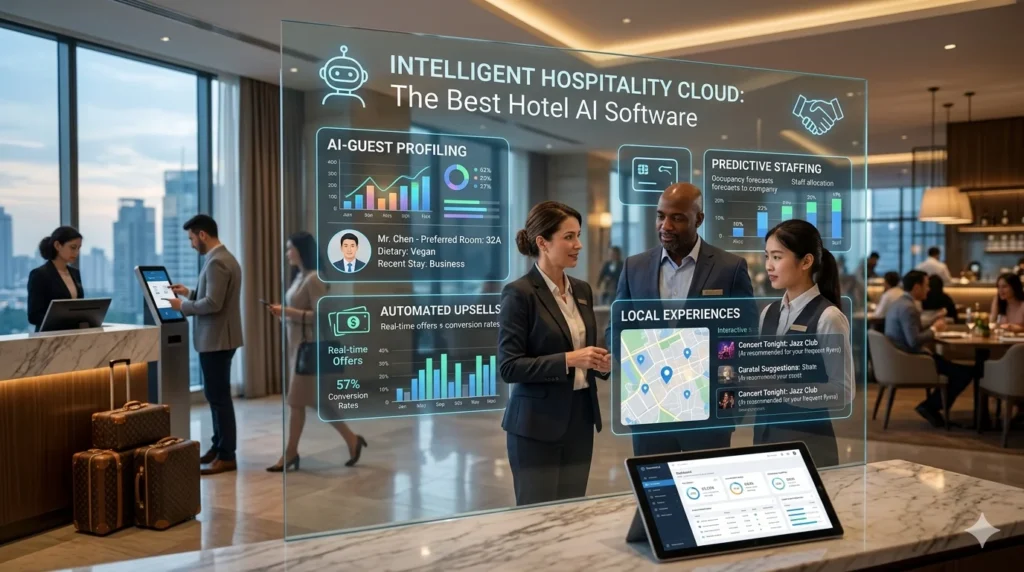
AI enables personalization at a scale that manual processes simply can’t match. Platforms can analyze past stay data, booking behavior, and in-stay patterns to tailor room assignments, pre-arrival communications, upsell offers, and post-stay follow-ups to individual guests rather than broad segments.
The guest perception shift matters commercially. More than 60% of independent hotel guests in a recent survey reported that they appreciate or actively value AI-powered features — a figure that signals guests are not just tolerating AI but expecting it.
Data-Driven Insights and Predictive Analytics
One of the less-discussed advantages of AI software for hotels is the quality of the intelligence it generates. Predictive analytics platforms don’t just report on what happened — they identify patterns in historical data to surface what’s likely to happen next. For revenue managers, that means demand forecasts calibrated weeks or months out. For operations teams, it means predicting maintenance needs or staffing requirements before they become crises.
Types of AI Software Solutions for Hotels
AI Hotel Management Software
AI hotel management software covers the broadest scope — coordinating operations across departments, automating task workflows, and surfacing performance data in real time. The strongest platforms integrate with the hotel’s PMS to access live inventory, reservation, and operational data, turning that information into actionable recommendations rather than static reports.
| Software Type | Primary Function | Key Users |
| AI Hotel Management Software | Operations, workflow, cross-department coordination | GMs, operations teams |
| AI Hotel Pricing Software | Dynamic rate optimization across channels | Revenue managers, owners |
| AI Customer Service & Chatbots | Guest communication, FAQs, and booking support | Front desk, reservations |
| AI Business Intelligence Tools | Forecasting, market analysis, performance reporting | Revenue managers, ownership |
AI Hotel Pricing Software
AI hotel pricing software is the most directly revenue-generating category. It continuously adjusts room rates based on real-time signals — competitor pricing, booking pace, occupancy trajectory, local demand drivers — without requiring manual review on every decision. For a detailed breakdown of how AI and machine learning work in dynamic pricing for hotels, the mechanics of demand signal coordination are worth understanding before evaluating specific platforms.
The key differentiator between pricing tools is automation depth. Some require a revenue manager to approve every recommendation; others execute rate changes automatically within defined guardrails. The right choice depends on the property’s team size and risk tolerance.
AI Customer Service and Chatbots
Chatbots are the most widely deployed form of AI in hospitality — 42% of hotel chains currently use them. The best implementations go beyond FAQ handling to manage pre-arrival communication, room preference collection, in-stay service requests, and checkout follow-up. The value isn’t just cost reduction; it’s response speed and consistency at hours when front desk staff isn’t available.
AI-Powered Business Intelligence and Analytics Tools
Business intelligence platforms aggregate data across booking channels, competitive sets, and historical performance to generate forecasts and strategic insights. For an overview of how AI is reshaping the broader revenue strategy, this guide to AI hotel revenue management covers how modern platforms are moving beyond room pricing into full profit optimization. Properties using these tools make demand planning, marketing spend, and channel strategy decisions grounded in data — not experience alone.
How to Choose the Right AI Software for Your Hotel
Identifying Your Hotel’s Needs
Before comparing platforms, define the specific problem the software needs to solve. Vague goals produce vague evaluations. The most useful approach is to identify where time, revenue, or guest satisfaction is being lost today:
- Are staff spending hours on manual rate updates that automation could handle?
- Is the hotel consistently underpricing during demand peaks or discounting unnecessarily in shoulder periods?
- Are guest response times creating friction or complaints that AI communication tools could resolve?
- Is pricing and performance data scattered across systems with no centralized intelligence layer?
Each answer points toward a different category of AI software for hotels — and avoids the common mistake of buying the most feature-rich platform rather than the most relevant one.
Evaluating AI Software Features and Compatibility
Once needs are clear, feature evaluation becomes structured. The non-negotiables for any serious AI hotel management software include:
- PMS integration — two-way data exchange, not just one-directional rate pushing
- Real-time processing — rate decisions and operational signals acted on within minutes, not hours
- Override controls — human judgment preserved, with AI learning from those adjustments over time
- Transparent reasoning — the platform should explain why a rate or recommendation was generated, not just display the output
- Implementation speed — live within days or weeks, not after months of configuration.
Budget Considerations and ROI
AI software pricing varies widely, and the right framework is total cost of ownership rather than the headline subscription fee. Platforms that charge separately for PMS integration, onboarding, training, and data feeds often end up significantly more expensive than their advertised price. For context on what a complete revenue management software stack should include and cost, evaluating bundled vs. modular pricing models before shortlisting is time well spent.
ROI should be measurable within the first few months of deployment. If a vendor can’t point to verifiable case study outcomes or offer trial access with real data, treat that as a signal.
Vendor Reputation and Support
The quality of post-sale support is as important as the software itself. AI systems require calibration, especially in the early months when they’re learning a property’s demand patterns. Vendors who disengage after onboarding create systems that underperform their potential. Look for accessible account management, clear escalation paths, and a track record of staying engaged well beyond go-live.

Challenges in Implementing AI in Hotels
Overcoming Resistance to AI Adoption
The most common barrier to AI adoption isn’t technical — it’s cultural. Staff worry about job displacement; managers worry about ceding control over decisions they’ve made manually for years. Both concerns are addressable, but only if the implementation approach treats them seriously.
Effective AI adoption in hotels frames the technology as an enabler that handles the repetitive, data-heavy work — freeing staff to focus on the guest-facing interactions that actually require human presence. Override capability built into the system reinforces that message: the AI handles the defaults, but the team stays in control.
Integration with Existing Systems
The best hotel AI software for the hospitality industry is only as effective as its connection to the existing technology stack. Fragmented integration means the AI operates on incomplete data — producing recommendations that don’t reflect actual availability, real-time booking status, or current competitive positioning.
Before committing to any platform, map the full integration chain: PMS to AI system, AI system to channel manager, channel manager to distribution channels. Verify that rate changes propagate fully and quickly throughout, and that historical PMS data is accessible for demand modeling.
Data Privacy and Security Concerns
AI systems in hotels process significant volumes of guest data — booking history, preferences, communication records, and payment information. GDPR compliance, local data protection regulations, and PCI DSS requirements all apply, and the vendor’s approach to data security should be a standard evaluation criterion, not an afterthought.
Ask vendors where guest data is stored, how it’s encrypted, who has access, and what the breach notification process looks like. Properties that skip this step during evaluation often discover the gaps after a contract is signed.
Choosing AI That Fits — Not Just AI That Impresses
The best hotel AI software for the hospitality industry isn’t the one with the longest feature list. It’s the one that solves the specific operational and revenue problems a property faces today, integrates cleanly with existing systems, and delivers measurable results within a reasonable timeframe.
The hotels leading on AI performance right now aren’t necessarily those that deployed the most sophisticated tools — they’re the ones that deployed the right tools for their context and built the internal discipline to use them effectively. Explore what a purpose-built AI pricing platform designed specifically for hotel revenue optimization looks like in practice.