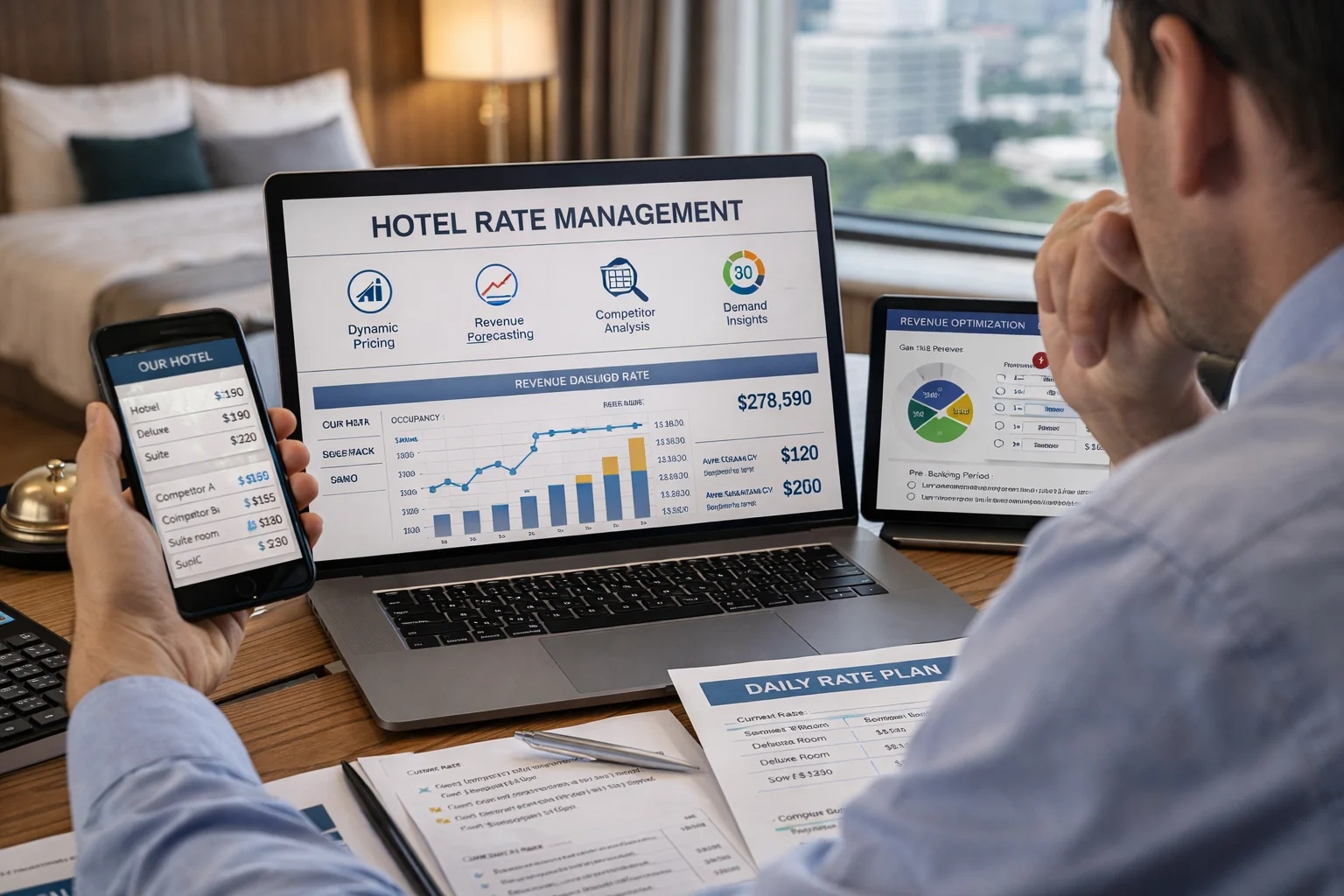
Getting pricing right in the hotel industry has never been more demanding. Guest expectations shift faster, OTA competition intensifies by the quarter, and the window to capture revenue on any given night closes at midnight — permanently. Hotel rate management sits at the center of all of it, determining not just how much a property earns per room, but how confidently a revenue team can plan, compete, and grow.
The challenge isn’t a shortage of data. Most hotels are drowning in it — booking pace reports, competitor feeds, historical occupancy trends, channel performance figures. The real problem is converting that data into timely, accurate pricing decisions at scale. That’s precisely where technology has changed the game, shifting hotel rate management from a manual, reactive process into a structured, forward-looking discipline that drives measurable results.
The Role of Technology in Hotel Rate Management
How Hotel Rate Management Software Revolutionizes Pricing Decisions
Hotel rate management software consolidates the inputs that pricing decisions depend on — demand forecasts, competitive benchmarks, booking curves, segment behavior — into a single platform that surfaces recommendations and, in many cases, acts on them automatically. Rate changes that once required hours of spreadsheet work now happen in minutes, with far less risk of human error or channel inconsistency.
As Skift Research notes, planned technology investments across the travel sector are set to rise by 14%, with 91% of travel companies expecting moderate to aggressive growth in tech spending — a direct reflection of how central software has become to competitive revenue strategy.
Revenue Management Systems and Their Integration with Rate Management
A Revenue Management System (RMS) is the operational engine that drives hotel rate management at scale. It integrates with the Property Management System (PMS) and channel manager to pull real-time booking data, apply pricing logic, and push rate updates across every distribution channel simultaneously. That integration closes the gap between insight and action — recommendations don’t sit in a report waiting for someone to act; they execute automatically within defined parameters.
The most valuable RMS integrations go beyond room inventory. When rate management connects with F&B systems, group booking platforms, and CRM data, pricing decisions can account for total guest revenue rather than just room revenue — a more accurate picture of what each booking is actually worth.
Artificial Intelligence and Machine Learning in Rate Optimization
AI and machine learning have extended what rate management systems can do by learning from patterns that fixed rules miss. Rather than applying preset logic — “raise rates when occupancy exceeds 80%” — ML models identify relationships between dozens of variables simultaneously: search traffic volume, competitor availability, lead time behavior, local event calendars, and weather forecasts. The result is pricing recommendations that adapt to actual market dynamics rather than simplified proxies for them.
The compounding benefit is that these models improve over time. Each pricing decision generates outcome data that feeds back into the model, making future recommendations progressively sharper. For hotels with limited revenue management staff, AI effectively scales decision-making capacity without scaling headcount.

Best Practices for Hotel Rate Management
Using Historical Data for Smarter Pricing Decisions
Historical booking data is the foundation of credible demand forecasting. Year-over-year occupancy patterns, booking window trends, cancellation rates by segment, and RevPAR performance by day of week all inform where rates should be set for any given future date. The discipline is in reviewing this data regularly and updating assumptions when market conditions shift — not simply copying last year’s rate strategy and hoping demand behaves the same way.
The most useful historical data points to track include:
Booking pace by date — how far in advance rooms typically fill for any given period
Cancellation rate by segment and channel — which booking sources carry the most revenue risk
RevPAR by day of week — reveals structural patterns that inform minimum stay and rate floor decisions
Pickup curves for past events — how demand built in the weeks before comparable local events
A useful resource for structuring this analysis is the guide to hotel revenue forecasting methods and best practices, which covers pickup analysis and booking curve tracking for more reliable short- and long-term pricing decisions.
Competitor Rate Monitoring and Benchmarking
Pricing in isolation is pricing blind. A rate that looks strong against internal targets may be entirely uncompetitive if the comp set has shifted. Systematic competitor monitoring — tracking rate changes across a defined set of comparable properties in real time — gives revenue managers the context to position rates accurately rather than guessing where the market sits.
The benchmarking discipline matters as much as the monitoring itself. Setting rates 10% above the comp set means nothing without clarity on whether that premium reflects genuine product differentiation.
Honest benchmarking forces that conversation.
Dynamic Pricing and Real-Time Rate Adjustments
Dynamic pricing is the execution layer of effective hotel rate management — adjusting room rates continuously based on live demand signals, competitor moves, and booking pace. For a practical breakdown of how this works across different demand scenarios, AI and dynamic pricing for hotels covers how AI-driven systems handle real-time adjustments without requiring constant manual oversight.
Pricing for Different Customer Segments
Not all guests have the same price sensitivity, booking behavior, or revenue contribution. Effective hotel rate management best practices account for these differences by applying distinct pricing logic per segment:
- Business travelers — typically short lead times, low price sensitivity, high repeat value; prioritize rate integrity over discounts
- Leisure guests — longer planning horizons, more price-sensitive; respond well to early bird offers and value packages
- Group bookings — negotiated rates set months in advance; managed separately with volume-based logic and attrition clauses
- Last-minute bookers — high fill value during low-demand periods; best targeted with dynamic floor rates rather than blanket discounts
Segmentation also shapes channel strategy. A last-minute leisure deal distributed through OTAs fills a room, but at a margin materially lower than a direct booking. Rate management software that tracks segment performance by channel makes those trade-offs visible and quantifiable.
Technology-Driven Solutions for Hotel Rate Management
Cloud-Based Rate Management Systems: Benefits and Features
Cloud-based hotel rate management systems have replaced on-premise infrastructure as the standard for properties of all sizes. Updates deploy automatically, remote access is seamless, and integration with cloud-based PMS and channel manager platforms is straightforward.
The more significant advantage is scalability — cloud systems handle portfolio-level rate management across dozens of properties without proportional increases in cost or complexity.
Key features to look for in a cloud-based hotel rate management system:
- Real-time competitor rate feeds are integrated directly into the pricing workflow
- Automated rate pushes across all connected distribution channels simultaneously
- Demand forecasting dashboards with configurable date ranges and segment breakdowns
- Override controls that let revenue managers apply manual judgment without disabling automation
- Audit trails showing what rate changes were made, when, and why
For a detailed breakdown of what modern platforms should include, the Ramsi overview of hotel revenue management software is a practical reference covering core features and what distinguishes effective systems from legacy tools.
Automated Rate Adjustments and Predictive Analytics
Automation addresses one of the most persistent bottlenecks in hotel rate management: the time between identifying the right rate and applying it. Predictive analytics platforms generate forward-looking demand forecasts that allow rate adjustments to be scheduled in advance — not just reacted to in the moment. A hotel can act on a projected demand spike days before it materializes, rather than scrambling to reprice when it’s already visible in the booking data.
The practical result is a more consistent rate optimization across the full booking window, including periods that manual review processes tend to overlook — midweek dates three weeks out, or low-occupancy shoulder nights that quietly underperform year after year.
Integrating Rate Management Systems with Other Hotel Management Tools
Rate management doesn’t operate in isolation. Its effectiveness multiplies when connected to the broader technology stack — PMS, channel manager, CRM, and booking engine. These integrations ensure that rate decisions reflect complete, current data from across the operation, and that changes propagate correctly without manual data entry between systems.
Integration with a CRM, in particular, enables rate personalization that generic systems can’t replicate: offering returning guests preferred rates based on actual booking history, or adjusting package pricing based on past ancillary spend.

Challenges and Solutions in Hotel Rate Management
Overcoming the Complexity of Pricing Across Multiple Channels
Managing consistent rates across direct booking, OTAs, GDS, and group channels simultaneously is one of the most operationally complex aspects of hotel rate management. Rate parity violations — even unintentional ones — erode trust with OTA partners and confuse guests who find different prices for the same room on different platforms.
A well-integrated rate management system eliminates most of this risk by acting as the single source of truth for rate distribution, pushing updates to all channels in real time from one central platform.
Balancing Profitability with Guest Satisfaction
| Pricing Scenario | Revenue Impact | Guest Perception Risk |
| Aggressive peak pricing | High short-term RevPAR | Negative if perceived as gouging |
| Flat seasonal rates | Predictable but capped upside | Missed revenue during demand surges |
| Dynamic + floor pricing | Optimized RevPAR | Neutral if rate logic is transparent |
| Personalised loyalty rates | Strong direct booking conversion | Positive — perceived as rewarding |
The tension between maximizing rate and maintaining guest trust is manageable. Hotels that communicate pricing rationale clearly — through transparent cancellation policies, loyalty rate benefits, and consistent value delivery — can charge premium rates without eroding satisfaction scores.
Technology as the Foundation of Sustainable Rate Performance
The benefits of investing in hotel rate management technology compound over time. Better data produces sharper forecasts, sharper forecasts enable more accurate pricing, and accurate pricing generates outcome data that improves the next round of decisions.
The hospitality market is moving toward greater automation and AI-driven personalization at a pace that manual rate management simply cannot match. Hotels that build this foundation now will be structurally better positioned to compete as those trends accelerate — while those that delay find the performance gap progressively harder to close.
Ready to put smarter hotel rate management into practice? Explore how Ramsi’s agentic AI revenue management platform helps hotels of every size price with precision — automatically, consistently, and in real time.