
Room revenue doesn’t manage itself. Behind every well-timed rate increase or strategically timed discount is a system that processes dozens of market signals faster than any human team could. Hotel dynamic pricing software sits at the heart of that process — adjusting rates in real time based on occupancy levels, competitor moves, demand forecasts, and booking behavior to ensure every room is priced at what the market will actually bear.
The stakes are real. According to a BCG report covered by PhocusWire, hotels implementing AI-powered pricing systems are seeing RevPAR gains of up to 15%. The difference between properties achieving those results and those still relying on spreadsheets isn’t luck — it’s the quality of the tools and how well they fit the operation. This guide breaks down the seven features that separate effective platforms from overpriced ones.

Top 7 Features to Look for in Hotel Dynamic Pricing Software
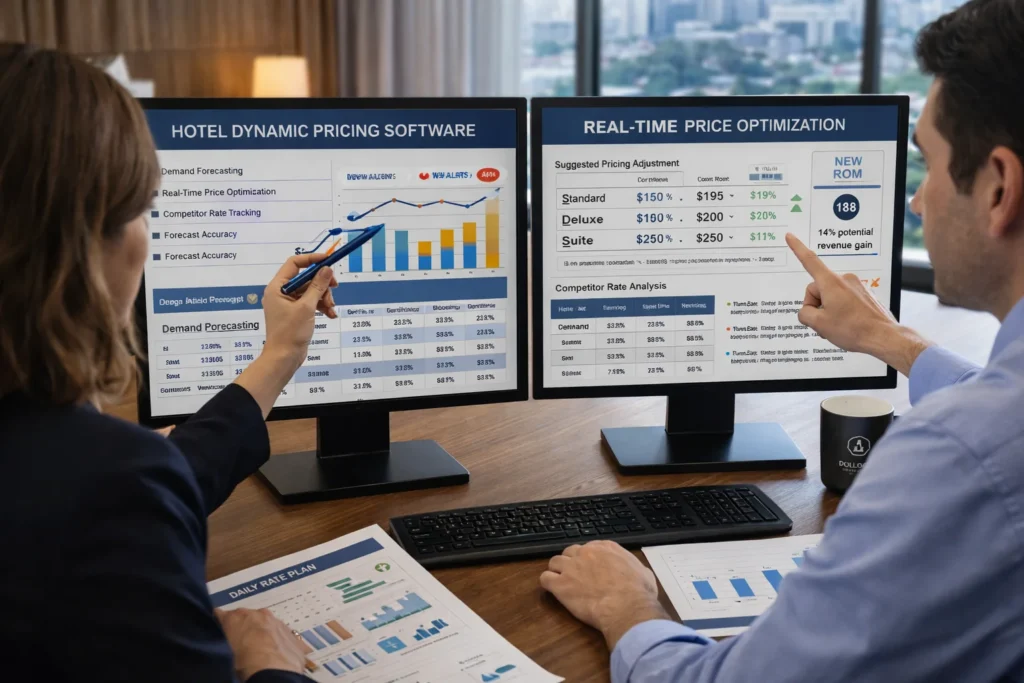
Feature #1: Real-Time Price Adjustments
The defining capability of any dynamic pricing tool is its ability to update rates continuously, without waiting for a daily review or manual trigger. Demand conditions in hospitality change fast — a competitor selling out, a local event announcement, a surge in search activity — and the revenue window on any given night is finite. Software that updates rates in real time captures the upside that lagged systems simply miss.
What separates strong real-time engines from basic ones is the breadth of signals they process. The best hotel dynamic pricing software monitors all of the following simultaneously and translates them into a pricing decision within minutes:
- Booking pace — whether reservations are coming in faster or slower than historical norms for that date
- Competitor availability — how many rooms comparable properties still have to sell
- Channel performance — which distribution points are driving conversion and at what margin
- Cancellation patterns — early signals of demand softening before it shows up in occupancy figures
Feature #2: Advanced Data Analytics and Forecasting
Dynamic pricing that only responds to current conditions is reactive by nature. Predictive analytics takes that a step further, allowing hotels to price ahead of demand rather than scrambling to catch up with it. When software can forecast demand spikes for dates weeks or months out — based on historical pickup curves, event calendars, and booking window trends — revenue teams can position rates proactively instead of reacting when it’s already too late to capture full value.
As HospitalityNet notes, 2026 marks a shift from reporting to prediction — with AI systems incorporating forward-looking signals to help hotels price ahead of demand, not behind it. Forecasting dashboards should be configurable by date range, segment, and channel.
Feature #3: Competitor Rate Tracking and Market Intelligence
Pricing in isolation is pricing blind. A rate that looks profitable against internal cost targets may be entirely uncompetitive if the comp set has shifted. Robust competitor rate tracking pulls live pricing data from a defined set of comparable properties, surfacing how a hotel’s rates compare across room types and date ranges in real time.
The benchmarking layer matters as much as the raw data. Knowing a competitor charges $189 for a standard room on a Friday is useful; understanding that this represents a 12% premium over their 30-day average — and that two other comp set hotels are sold out — is what actually drives a confident pricing decision. Look for software that contextualizes competitor data rather than just displaying it.
Feature #4: Integration with Property Management Systems and Booking Engines
Dynamic pricing software only delivers its full value when connected to the systems that manage inventory and distribute rates. Integration with the PMS ensures rate recommendations are based on accurate, current availability data. Integration with the booking engine and channel manager ensures that when a rate changes, it propagates correctly across every distribution point without manual entry.
Gaps in integration create rate inconsistencies that confuse guests and trigger OTA penalties, plus a lag between decisions and deployment that undermines real-time capability. When evaluating dynamic pricing software for hotels, verify not just which PMS integrations exist, but how quickly rate changes flow through the full stack.
Feature #5: User-Friendly Interface and Customization Options
The most sophisticated pricing engine is only as useful as the team’s ability to operate it confidently. Revenue management in many hotels falls on general managers or owners rather than dedicated specialists — meaning software requiring weeks of training will go underutilized regardless of its underlying capability.
A well-designed interface surfaces key decisions clearly: what rates are recommended, why, what the alternatives are, and how to override when judgment calls for it. Beyond navigation, customization matters.
Every property has different rate floors, segment priorities, and competitive dynamics. Effective software lets hotels configure pricing rules, set guardrails, and define minimum and maximum rate boundaries that reflect their specific strategy — not just a generic algorithm.
Feature #6: Multi-Channel Distribution Support
A rate decision means nothing if it doesn’t reach every channel where guests are booking. Effective hotel dynamic pricing software must manage pricing consistently across all major distribution points simultaneously:
- OTAs (Booking.com, Expedia, Airbnb) — highest volume, highest commission cost
- Direct booking channel — best margin, requires rate incentives to drive preference
- GDS — critical for corporate and travel agent segments
- Wholesale and bed banks — contracted rates that need monitoring against live market rates
Rate parity matters here in two directions. Inconsistent pricing across channels erodes direct booking incentives and can strain OTA relationships.
But multi-channel support isn’t just about avoiding problems — it’s about optimizing each channel’s contribution to overall revenue. Software that tracks performance by channel gives revenue teams the data to adjust distribution strategy over time, not just maintain consistency in the moment.
For a closer look at how channel management intersects with dynamic pricing strategy, the AI and machine learning in hotel dynamic pricing breaks down how automated channel distribution supports revenue optimization without manual overhead.
Feature #7: Automation and AI-Driven Decision Making
Automation is what turns a capable pricing tool into a genuine competitive advantage. Manual pricing reviews — even daily ones — create windows where rates sit misaligned with market conditions. AI-driven automation closes those windows by executing rate adjustments continuously, based on live data, without waiting for a human to initiate a review.
The value extends beyond speed. AI systems learn from outcomes over time, refining recommendations as they accumulate data on what pricing decisions produced what results. This compounding improvement is something rule-based systems can’t replicate — and it’s why AI-powered tools consistently outperform traditional RMS platforms in revenue impact over time.
Critically, automation should come with a human override capability. The best systems apply automation as the default while giving revenue managers clear controls to step in when property-specific context — a VIP group arrival, a strategic rate hold — calls for it.
How to Choose the Best Hotel Dynamic Pricing Software for Your Business
Assess Your Property’s Specific Needs First
Before comparing platforms, clarify what problem you’re actually trying to solve. A 20-room independent property with one revenue manager has different requirements than a 200-room full-service hotel with a dedicated pricing team. The features that matter most — automation depth, multi-property support, integration flexibility — depend heavily on your operational context.
Consider these questions before shortlisting platforms:
- How many hours per week does your team currently spend on manual rate management?
- Which PMS and channel manager do you use, and how robust are the integration options?
- Do you need multi-property capability, or is this a single-property decision?
- What’s your current visibility into competitor pricing, and is it real-time or delayed?
For hotel owners and asset managers overseeing multiple properties, scalability and portfolio-level reporting should weigh heavily — a system that works well for one property but can’t consolidate insights across a portfolio creates more work, not less.
Evaluate Ease of Implementation and Ongoing Support
Even the best hotel software with dynamic pricing capabilities delivers poor ROI if implementation takes months and ongoing support is difficult to access. Ask vendors directly how long a typical onboarding takes, what data migration looks like, and what the support model is once the system is live.
Total cost of ownership matters more than the headline subscription fee. Some platforms charge separately for PMS integration, training, and competitor data feeds. For management companies running pricing across a portfolio, per-property costs compound quickly, so transparency is essential. Look for platforms offering trial access with real data and speak to similar properties already using the software.
The Right Software Pays for Itself
The seven features covered here aren’t a wish list — they’re the baseline for what effective hotel dynamic pricing software looks like in a market where competitors are already using these capabilities. Real-time adjustments, predictive analytics, competitor intelligence, seamless integrations, intuitive controls, multi-channel support, and AI automation together turn pricing from a reactive chore into a proactive revenue driver.
The question isn’t whether to invest — the data makes that case. The question is which platform fits your property’s size, team, and ambitions. Explore how Ramsi’s agentic AI platform brings all seven features together in a solution built for hotels of every size — without the complexity of legacy systems.