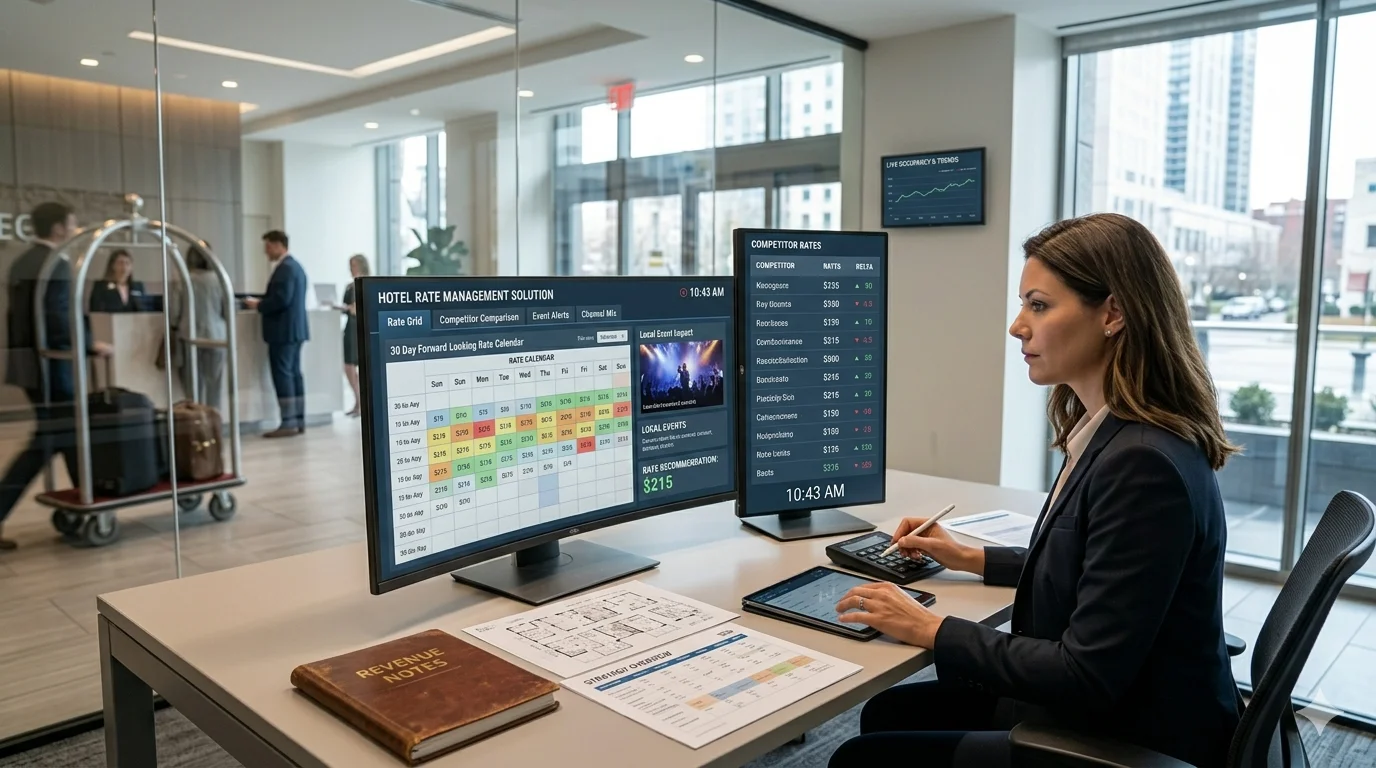
A room that goes unsold tonight generates zero revenue — and that opportunity is gone forever. A rate set too low during peak demand leaves margin permanently on the table. Hotel revenue management exists to prevent both outcomes, ensuring every room is priced at what the market will actually bear, through the right channel, at the right time.
Hotel revenue management solutions (RMS) are the technology that makes this possible at scale. Rather than relying on spreadsheets and weekly pricing reviews, modern platforms use real-time data, automated rate adjustments, and demand forecasting to keep pricing aligned with market conditions continuously.
According to Skift Research, planned technology investments across the travel sector are set to rise by 14%, with 91% of travel companies expecting moderate to aggressive growth in tech spending — a clear signal that data-driven revenue management is no longer optional.
Why You Need the Right Hotel Revenue Management Solution
Optimizing Revenue in a Competitive Market
Manual pricing processes can’t keep up with modern market dynamics. OTAs update competitor rates in near real time, guests compare options across multiple platforms before booking, and demand shifts faster than any weekly review cycle can track. A property still relying on instinct and periodic adjustments is perpetually behind, reacting to demand that more agile competitors have already priced into.
The right hotel revenue management solution closes that gap by monitoring conditions continuously and acting automatically, adjusting rates based on live signals — booking pace, competitor availability, cancellation trends, local events — without manual approval on every decision.
Maximizing Profitability with Data-Driven Decisions
Data-driven pricing prevents two expensive mistakes equally: charging too much when demand is soft, and discounting when it isn’t necessary. The second is far less visible but just as damaging — unnecessary discounting erodes ADR quietly without ever appearing in a single bad night’s report.
Revenue management solutions for hotels surface these patterns by tracking performance against forecasts and benchmarking rates against the competitive set. The result is pricing grounded in what the market is doing, not what it did last season.
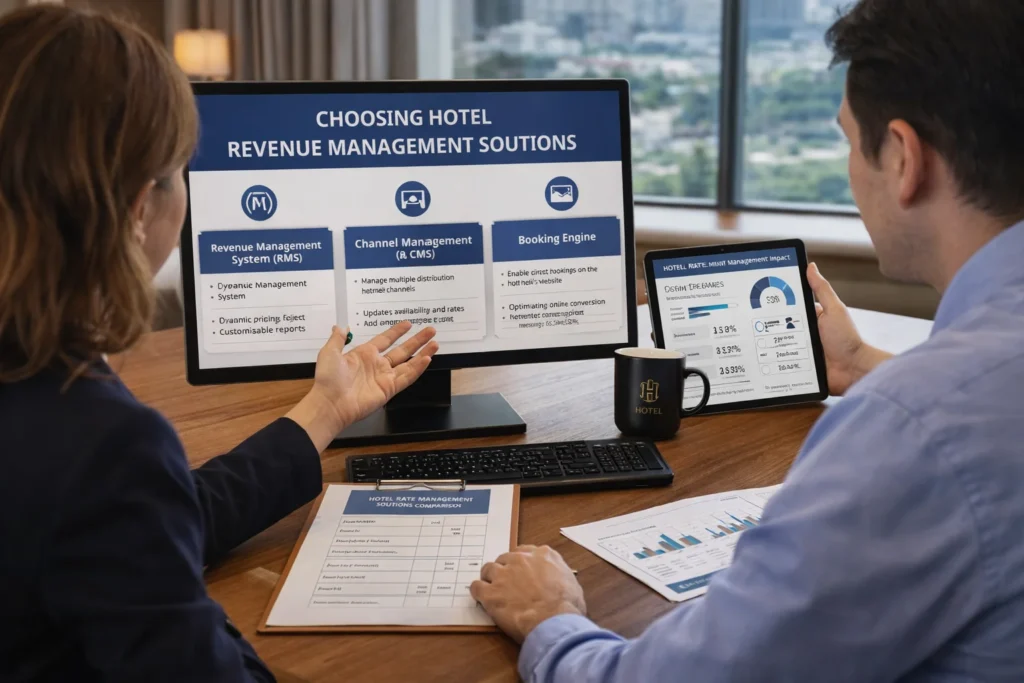
Key Features to Look for in Hotel Revenue Management Solutions
Feature #1: Dynamic Pricing and Real-Time Rate Adjustments
Dynamic pricing is the operational core of any effective RMS — adjusting room rates continuously based on live demand signals rather than predetermined schedules. Look for solutions that push rate changes automatically across all connected channels simultaneously, with configurable rate floors and ceilings that keep automation within the boundaries the hotel sets.
Manual override capability is equally important: the best systems automate by default while keeping revenue managers fully in control when property-specific judgment is needed.
Feature #2: Advanced Forecasting and Demand Prediction
Forecasting separates platforms that react from those that anticipate. The best advanced hotel revenue management solutions generate demand predictions by pulling from multiple data sources:
- Historical pickup data — year-over-year occupancy patterns and booking window trends by date
- Forward-looking event calendars — conferences, festivals, and local events driving known demand spikes
- Competitive set signals — how comp set pricing is shifting ahead of specific date ranges
- Search and booking pace trends — early indicators of demand before it becomes visible in reservations
Date-specific rate recommendations should be actionable and clearly explained — not raw data that requires interpretation before anyone can act on it.
Feature #3: Integration with Property Management Systems and Other Hotel Software
An RMS disconnected from the hotel’s PMS operates on stale data. Integration with the PMS is what enables the system to access accurate, current inventory and push rate changes to the booking engine and channel manager in real time. Before committing to any platform, verify these specifics:
- How quickly do rate changes flow from the RMS to all connected distribution channels?
- Is PMS integration included in the base subscription, or billed separately?
- Does the system support two-way data exchange, or only one-directional rate pushing?
- Which PMS platforms does the vendor actively maintain integrations with?
As PhocusWire notes, hotels are increasingly extending revenue management beyond rooms — into F&B, spa, and meeting space — making broader software connectivity a growing strategic priority.
Feature #4: Competitive Benchmarking and Market Intelligence
Pricing without competitor context is pricing blind. Strong hotel revenue management solutions pull live rate data from a defined comp set and present contextual benchmarking — showing how a hotel’s rates compare across room types, date ranges, and lead time windows, not just a raw feed of numbers.
The benchmarking layer should support both tactical decisions (is tonight’s rate competitive given what the comp set still has available?) and longer-range strategic ones (is my positioning for the upcoming event consistent with last year’s results?). Platforms offering only one level of visibility leave gaps in both directions.
Feature #5: User-Friendly Interface and Customization Options
Algorithm sophistication is irrelevant if the team managing rates can’t navigate the platform confidently. In many properties — particularly independent and boutique hotels — the person responsible for pricing is a general manager or owner with a dozen other responsibilities, not a dedicated revenue analyst.
Effective software balances intuitive navigation with meaningful customization. Rate floors, segment priorities, automation guardrails, and competitive positioning parameters should all be configurable to reflect the hotel’s actual strategy — not imposed by a one-size-fits-all algorithm. A practical breakdown of what to look for is covered in this guide to revenue management software for hotels.
Feature #6: Reporting and Analytics Tools
Good reporting closes the feedback loop that sharpens future pricing decisions. The platform should surface not just what happened — occupancy, ADR, RevPAR — but why: which rate decisions drove pickup, where discounting was unnecessary, and how actuals tracked against forecast. This visibility supports day-to-day management and the transparency ownership groups need when connecting pricing performance to asset-level returns.
How to Evaluate the Best Hotel Revenue Management Solution for Your Business
Understanding Your Hotel’s Specific Needs
The right evaluation criteria vary significantly by property type, team size, and operational context. A 25-room independent property has very different requirements from a 300-room full-service hotel or a portfolio operator. Before shortlisting platforms, answer these questions:
- What specifically breaks down in the current pricing process — accuracy, speed, or channel consistency?
- How many hours per week does the team spend on manual rate management?
- Which PMS and channel managers are in use, and how well does the vendor support them?
- Is single-property functionality sufficient, or is multi-property management required?
- How much automation is the team ready to trust, and what override controls are needed?
Evaluating Features and Benefits of Different Solutions
With needs mapped, platform comparison becomes structured. Score each shortlisted solution against the features that matter most for your property type. Weight integration reliability and implementation speed heavily — a feature-rich platform that takes three months to configure will underperform a simpler system that’s live and accurate within the first week.
Key comparison criteria:
- Automation depth — how much can run without daily manual intervention?
- Forecast accuracy — does the vendor provide verifiable outcomes or trial access with real data?
- Implementation timeline — how long from contract to live automated pricing, and who manages setup?
- Total cost — are PMS integration, training, and competitor data bundled or priced separately?
- Scalability — does the solution support portfolio growth without a full platform switch?
Properties ready to move beyond manual pricing can explore AI-powered revenue management built around exactly this kind of automated, data-coordinated approach.
Considering Implementation and Ongoing Support
Implementation quality determines whether a platform’s capabilities translate into actual revenue results. Ask vendors directly: how long does onboarding take, who handles PMS connection and configuration, and what training is provided? A platform requiring significant IT resources or weeks of setup carries a hidden cost that the subscription fee doesn’t capture.
Ongoing support matters just as much. Pricing decisions happen every day — when a system behaves unexpectedly, fast access to knowledgeable support is the difference between a resolved anomaly and a week of misaligned rates.

The Future of Hotel Revenue Management Solutions
From Room Revenue to Total Revenue Optimization
The scope of hotel revenue management is expanding. Forward-thinking properties are applying dynamic pricing logic beyond rooms — to restaurant covers, spa bookings, parking, and meeting space.
Advanced hotel revenue management solutions are beginning to support this holistically, treating every revenue-generating asset as an optimization opportunity. This shift demands deeper system integration, but the upside for properties that build toward it is substantial — particularly for independent hotels where every revenue stream counts.
AI-Driven Personalization as the New Competitive Standard
The next evolution is personalization at scale — tailoring pricing to individual guest segments, booking channels, loyalty tiers, and behavioral signals, rather than a single rate per room type per date. The infrastructure is already forming. Properties that invest in the right RMS now will be better positioned to activate this capability as it matures.
Pricing Precision Compounds Over Time
The right hotel revenue management solution doesn’t just improve this week’s RevPAR — it builds a pricing infrastructure that generates better data, sharper forecasts, and more accurate decisions over time.
The wrong one creates friction, inconsistency, and missed revenue that accumulates quietly. Evaluate solutions against your specific operational needs, weigh integration quality alongside features, and choose a platform built to scale with your business — explore what a modern hotel revenue management solution looks like in practice.