
A room priced too low during a sold-out weekend is revenue that can never be recovered. A room priced too high during a slow Tuesday loses the booking entirely. Dynamic pricing for hotel revenue management exists to solve both problems — adjusting rates in real time based on demand, competition, booking pace, and market conditions, so every room is priced at what the market will actually bear at that specific moment.
The shift from static seasonal rates to dynamic pricing is one of the most impactful operational changes a hotel can make. According to Skift Research, RevPAR growth across the hospitality sector is projected to be just 1.2% in 2024 under traditional approaches — while properties adopting AI-driven dynamic pricing consistently outperform that baseline. The competitive gap between hotels that price dynamically and those that don’t is widening, and the six steps below are how properties close it.
Benefits of Dynamic Pricing for Hotel Revenue Management
Maximizing Revenue and Profitability
The core promise of dynamic pricing is straightforward: charge more when demand is high, stimulate bookings when it isn’t. As HospitalityNet explains, dynamic hotel pricing software enables revenue management teams to capitalize on demand peaks — major events, holidays, high-occupancy periods — while strategically lowering rates during quieter stretches to attract price-sensitive travelers and prevent revenue loss from vacant rooms.
The less obvious benefit is the elimination of systematic pricing errors. Manual rate-setting consistently leaves money on the table in both directions: discounting during periods when demand would have supported a higher rate, and holding premium rates during stretches where flexibility would have filled more rooms. Dynamic pricing removes that guesswork.
Improving Occupancy and Demand Forecasting
A dynamic room pricing model for hotel revenue management systems doesn’t just set rates — it improves how demand is understood. By tracking booking pace, pickup curves, cancellation patterns, and forward-looking signals, the pricing system builds a continuously updated picture of demand. That picture feeds into more accurate forecasts, which in turn produce better rate decisions weeks and months out.
The forecasting benefit compounds over time. Structured hotel revenue forecasting transforms revenue management from a reactive process — adjusting rates after occupancy drops — into a proactive strategy where pricing is positioned in advance of demand signals, not behind them.
Staying Competitive with Real-Time Market Adjustments
Competitor rates change throughout the day. A hotel that monitors its competitive set manually — or not at all — is making pricing decisions in the dark. Dynamic hotel pricing software revenue management benefits include continuous competitor rate tracking, which surfaces how a hotel’s pricing sits relative to the market at any given moment across room types, date ranges, and lead times.
Real-time responsiveness matters commercially. A competitor selling out on a Friday night is a revenue opportunity for surrounding properties — but only if rates respond within hours, not at the next morning’s review.
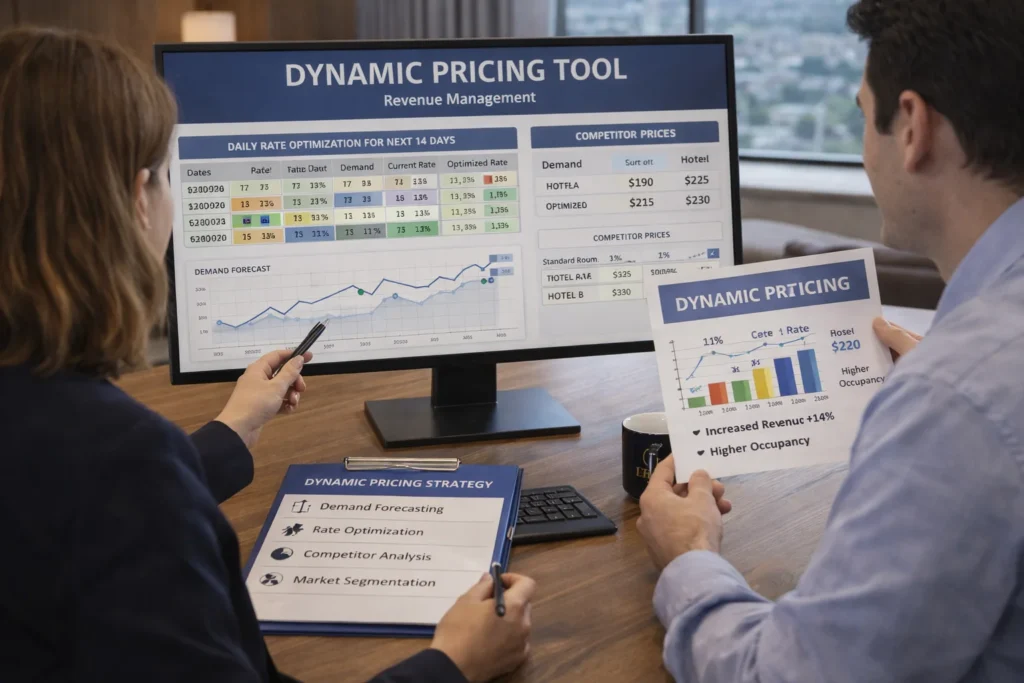
How to Implement Dynamic Pricing for Hotel Revenue Management
Step 1: Define Your Pricing Strategy and Objectives
Before selecting any software or configuring any rules, define exactly what the pricing strategy is meant to achieve. “Maximize revenue” is too vague; “increase RevPAR by 12% over the next 12 months while maintaining an 80% minimum occupancy target” is actionable.
Clear objectives determine which pricing rules to configure, which demand signals to weight most heavily, and where the rate floor should sit. They also establish the baseline against which results can be measured — a step many properties skip and then regret when evaluating whether dynamic pricing is delivering.
Step 2: Choose the Right Hotel Revenue Management Software with Dynamic Pricing
The software decision is the most consequential step. Hotel revenue management software with dynamic pricing should integrate directly with the PMS and channel manager, process multiple demand signals simultaneously, and push rate changes to all distribution channels in real time without manual intervention.
Key criteria when evaluating platforms:
- Automation depth — does the system execute rate changes automatically, or only generate recommendations?
- Data inputs — which signals does it process: competitor rates, booking pace, events, weather, cancellation trends?
- PMS integration — two-way exchange, real-time inventory access, and rapid rate propagation
- Transparency — does it explain why a rate was recommended, or just surface the output?
- Override controls — can revenue managers adjust or override decisions without disabling automation?
A practical breakdown of what these platforms should include is covered in this guide to revenue management software for hotels.
Step 3: Integrate Your Pricing Strategy with Other Hotel Systems
Dynamic pricing only delivers its full value when connected to the broader hotel technology stack. A dynamic room pricing model for hotel revenue management systems that operates in isolation — making recommendations without access to accurate, live inventory data — is working from a partial picture.
The critical integrations are:
- PMS — live availability, reservation data, and historical booking patterns
- Channel manager — rate propagation across OTAs, GDS, and direct booking channels
- CRM — guest segment data that informs rate personalization and loyalty pricing
Map these connections before go-live and verify that rate changes flow through the full stack completely and quickly after each pricing decision.
Step 4: Collect and Analyze Data to Inform Pricing Decisions
Dynamic pricing is only as accurate as the data behind it. Before the system can forecast demand reliably, it needs sufficient historical data to identify patterns: occupancy by day of week, ADR performance by season, booking window trends by segment, and comp set rate behavior around past events.
Properties migrating from manual pricing often underestimate how much of this data is already available in the PMS — and how quickly it can be made useful once extracted and structured correctly. The investment in data quality at setup pays dividends in forecast accuracy from the first month of operation.
Step 5: Monitor and Adjust Prices in Real-Time
Once live, effective dynamic pricing requires ongoing oversight — not daily manual rate-setting, but active monitoring to catch anomalies, review override decisions, and verify that automation is behaving as intended. Revenue managers should regularly check that rates across all channels are consistent, that comp set tracking is accurate, and that the system’s demand signals reflect what’s actually happening in the market.
This monitoring layer is where human judgment adds the most value. For a detailed look at how AI and machine learning in hotel pricing handle real-time signal coordination, understanding the mechanics helps revenue managers know when to trust the automation and when to intervene.
Step 6: Test and Refine Your Pricing Strategy
Dynamic pricing is not a set-and-forget system. Rate rules, demand weights, floor settings, and comp set configurations all require periodic review as market conditions evolve. Properties that treat the initial configuration as permanent typically see a performance plateau within a few months.
A practical refinement cycle includes monthly reviews of forecast accuracy against actuals, quarterly assessments of rate positioning relative to the competitive set, and annual recalibration of seasonal demand assumptions. Each review produces adjustments that improve the next period’s performance.
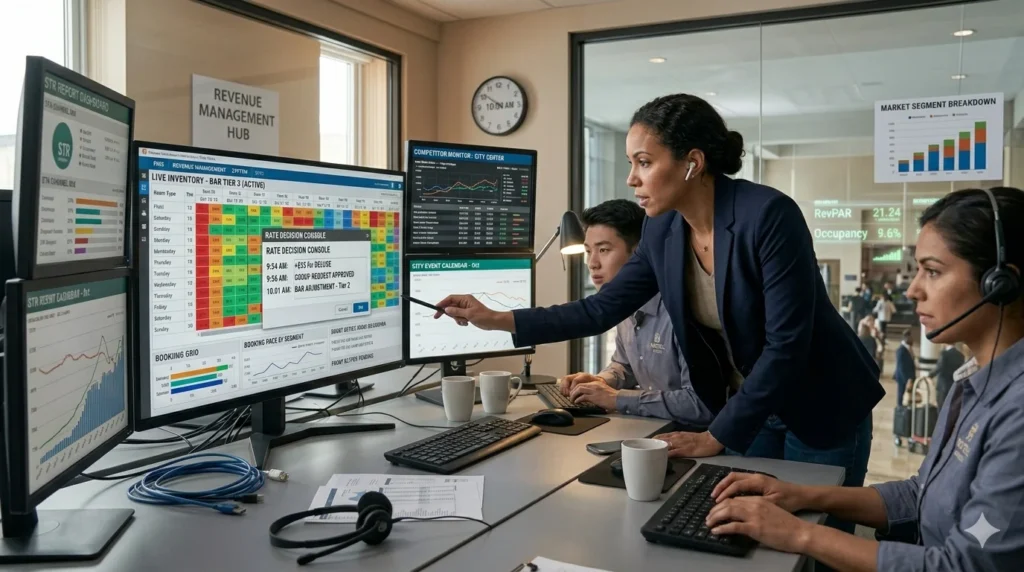
Challenges in Implementing Dynamic Pricing and How to Overcome Them
Avoiding Overpricing and Guest Alienation
The perception risk of dynamic pricing is real. Guests who notice that a room they viewed yesterday is priced significantly higher today can feel manipulated — particularly if the rate increase isn’t accompanied by obvious changes in availability or value. The mitigation is rate floor and ceiling guardrails that prevent algorithmically extreme pricing, and transparent communication about rate logic where relevant.
Data Accuracy and Integration Issues
A dynamic pricing system that receives inaccurate or delayed data from the PMS makes inaccurate rate decisions — and does so automatically, at scale. Data quality and integration reliability are non-negotiable. Before going live, validate that inventory data flows correctly from the PMS, that historical booking data has been loaded completely, and that comp set rate feeds are accurate and updating in near real time.
Resistance to Change from Staff and Guests
Staff who have managed rates manually for years often view dynamic pricing automation with skepticism — sometimes seeing it as a threat to their role rather than a tool that removes the most repetitive parts of it.
Effective implementation addresses this directly: frame automation as handling data-heavy decisions so the revenue team can focus on strategy, relationships, and the judgment calls that algorithms can’t make.
Guest resistance is less common than expected, particularly when pricing logic reflects genuine demand conditions rather than arbitrary increases.
Pricing That Learns From Every Decision
Dynamic pricing for hotel revenue management is not a one-time implementation — it’s a compounding system that improves as it accumulates data and learns from outcomes. The properties that extract the most value from it are those that commit to the full six-step process: clear objectives, the right software, clean integrations, quality data, active monitoring, and disciplined refinement.
Explore what a purpose-built dynamic pricing platform designed specifically for hotel revenue management looks like in practice — and how quickly the compounding begins.