
 Hotel Owners / Asset Managers
 Revenue Managers
 Revenue Management Consultants
 Management Companies
 Hotel Brands
 Independent Hotels
 Economy and Budget Hotels
 Integration Partners
 Blog
Blog FAQ’s
FAQ’s Case Studies
 Events
According to the AHLA 2025 State of the Industry Report, using STR and Oxford Economics data, U.S. hotel occupancy finished 2024 at 63.01%, still more than two and a half percentage points below the 2019 pre-pandemic benchmark of 65.80%. That gap represents a meaningful volume of unsold rooms, and in a market where organic demand growth has largely plateaued, waiting for recovery is no longer a viable strategy.
For hotel owners, revenue managers, and independent properties, the pressure is real. Costs have climbed. Labor budgets are tighter. And OTA commissions continue to erode margin on every booking they generate. The hotels closing that occupancy gap are not relying on market conditions to improve; they are actively working strategies that bring more guests through the door while protecting rate.

This article breaks down seven of those strategies in practical, implementable terms.
What Is Hotel Occupancy Rate and Why Should You Care?
The occupancy rate in hotel operations is the percentage of available rooms sold during a given period:
Occupancy Rate = Rooms Sold / Total Available Rooms × 100.
If a 100-room hotel sells 72 rooms on a given night, its occupancy rate is 72%.
It is one of the three core hotel performance metrics, alongside ADR and RevPAR, and it directly affects nearly every other part of the business. Higher occupancy means more food and beverage revenue, better staff utilization, stronger OTA ranking signals, and more opportunities for upselling. Lower occupancy creates the opposite: idle staff, fixed costs spread over fewer paying guests, and pressure to discount just to fill rooms.
What makes occupancy particularly important right now is that the industry has entered what PwC describes as a “normalization” phase, where rate-driven growth is slowing, and volume management matters more than it did during the post-pandemic rebound years. A hotel that doesn’t actively manage its occupancy rate in 2026 and beyond is effectively leaving revenue on the table every night.
7 Proven Strategies to Increase Hotel Occupancy Rate
1. Optimize Your Pricing Strategy with Dynamic Pricing
Dynamic pricing is the practice of adjusting room rates in real time based on demand signals, competitor rates, booking pace, and local market conditions. It is the single most effective lever for balancing occupancy and rate simultaneously.
The case for dynamic pricing is backed by current market data: only 23% of hoteliers adjust rates daily despite hourly pricing shifts in the market, which means a significant majority of properties are leaving rate optimization to chance. That gap represents a competitive opportunity for hotels that automate this process.
How to implement it:
- Audit your current pricing process. Identify how often rates are actually updated and who is responsible for making those changes.
- Define your demand signals: booking pace by day of week, local events calendar, competitor rate feeds, and channel mix by segment.
- Implement revenue management software or an AI-powered platform that adjusts rates automatically based on those signals — not just once a day, but continuously.
- Set rate floors and ceilings by room type and segment to prevent the system from discounting below your cost floor or pricing above your comp set ceiling.
Learn how Ramsi’s agentic AI manages dynamic pricing automatically for independent hotels and management companies.
2. Strengthen Your Online Presence and Booking Experience
Visibility drives bookings. A hotel that is not easy to find (or easy to book) on the channels where guests are searching is invisible to a significant portion of its potential market.
Hotel websites generated an average of $516 per booking in 2025, well above OTAs at $312, which makes direct channel investment both a revenue and a margin opportunity. Direct bookings also carry lower cancellation rates than OTA bookings, providing more stable demand forecasting.
Where to focus:
- SEO for your hotel website: Target location-based keywords, optimize page speed for mobile, and ensure your Google Business Profile is complete and up to date.
- OTA listing quality: High-quality photography, complete amenity descriptions, and a consistent review response rate all improve ranking within OTA algorithms.
- Booking engine UX: The path from “I want to stay there” to “booking confirmed” should require as few clicks as possible, with no surprises at checkout.
- Metasearch presence: Platforms like Google Hotel Search and Trivago allow direct booking links to appear alongside OTA rates, a critical channel for properties trying to shift volume away from commissionable bookings.
3. Offer Packages and Promotions That Add Value, Not Just a Discount
Discounting to fill rooms is a short-term fix that often creates long-term pricing problems. While a slashed rate might move the needle on occupancy today, it risks devaluing your brand and conditioning guests to never pay full price again. Packages solve the same occupancy challenge without the “race to the bottom” mentality; they add perceived value instead of reducing the baseline rate.
Strategic packaging allows you to obscure the room rate, protecting your price integrity while offering a more attractive total cost of ownership for the guest. The goal is to nudge short-stay guests toward longer stays or capture higher on-site spend without requiring a raw rate reduction.
Effective package structures include:
- Stay-and-dine: Room rate bundled with a dining credit, breakfast, or F&B allowance
- Seasonal experience packages: Targeted at leisure travelers during shoulder periods, incorporating local activities or amenities
- Early-booking discounts: A modest rate incentive for reservations made 30-60 days in advance, which improves booking pace without impacting peak-period rate
- Minimum-stay packages: Slight rate advantage for guests booking three or more nights, reducing turnover costs while increasing total revenue per reservation
The key is targeting these packages at demand troughs, the midweek slump, the off-peak shoulder season, the quiet weeks between holidays, rather than applying them broadly and eroding your rate across the board.
4. Use Social Media and Content Marketing to Build Demand
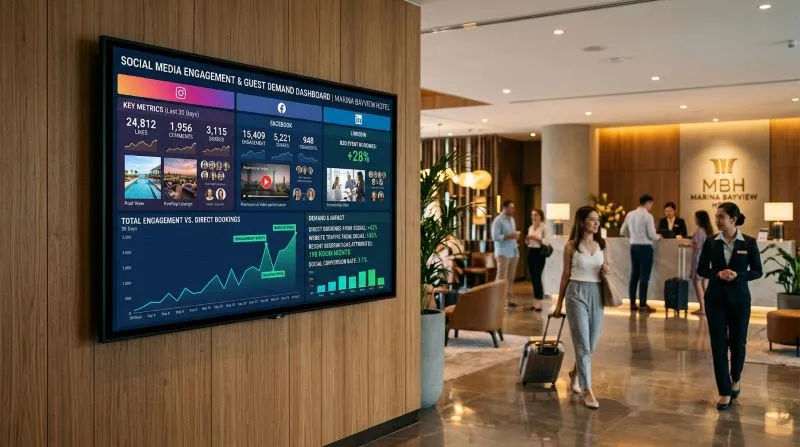
Social media does not directly fill rooms the way pricing or OTA visibility does. Instead, it builds the awareness and trust that eventually convert into bookings, especially for independent and boutique properties competing against branded giants with established name recognition.
Group and corporate bookings are driving significant demand in the current market. Much of that growth is captured by properties that maintain a visible, engaging presence on platforms where planners and travelers do their research. A hotel that looks active, welcoming, and detail-oriented on social media is easier to trust, and easier to book.
What works in practice:
- User-generated content (UGC): Encourage guests to tag the property and share their experience. UGC is more credible than branded content and costs nothing to produce.
- Influencer partnerships: For boutique and lifestyle properties, especially, a well-placed partnership with a travel creator in your target demographic can generate bookings that paid advertising cannot.
- Paid retargeting: Serve ads to visitors who browsed your website or booking page but did not complete a reservation. This audience has already expressed intent, retargeting converts them at a significantly higher rate than cold audiences.
- Consistent posting cadence: Properties that post regularly perform better in algorithm-driven feeds. Consistency matters more than production value.
5. Improve the Guest Experience to Drive Repeat Bookings
Repeat guests are among the most efficient sources of occupancy growth. They cost less to acquire than new guests, book more directly, cancel less often, and typically have higher lifetime value. A meaningful investment in guest experience is, at its core, an occupancy strategy.
Research from Cornell’s Center for Hospitality Research has shown that a one-point increase in a hotel’s review score allows a property to raise its rate by approximately 11% while maintaining the same occupancy, a direct revenue impact from a service improvement.
High-impact guest experience actions:
- Pre-arrival communication that personalizes the stay (room preferences, purpose of visit, special occasions)
- A structured follow-up process post-checkout, a brief email asking for feedback, with a direct link to your preferred review platform
- Resolution protocols that empower front desk staff to address complaints immediately, without requiring manager approval for small compensatory gestures
- Loyalty recognition for returning guests, even without a formal points program: an upgraded room when available, a welcome note, and a remembered preference
6. Actively Manage Reviews and Online Reputation
Online reviews are a direct driver of booking volume, not just a reflection of it. Properties with higher average review scores rank better on OTA platforms, convert more browsers into bookers, and support stronger rate positioning.
OTA guests cancel more than any other booking segment, which means that converting OTA lookers into direct or repeat bookers starts with reputation, guests who trust a property enough to book direct are the ones who found its reviews credible and consistent.
A practical reputation management approach:
- Respond to every review, positive and negative, within 48 hours. Response rate is factored into OTA ranking algorithms, and a thoughtful response to a critical review often matters more to prospective guests than the review itself.
- Identify recurring themes. If three reviews in a month mention slow check-in, that is an operational signal, not a coincidence. Address the root cause, not just the review.
- Make it easy to leave a review. Post-stay emails with a direct link to your preferred review platform dramatically increase submission rates compared to vague requests during checkout.
- Showcase reviews actively. Display recent positive reviews on your website’s booking page; the closer to the point of conversion, the more effective.
7. Target Corporate Clients and Group Bookings
Corporate and group business provides something that leisure transient demand rarely does: advance commitments, multi-room volume, and weekday occupancy. Business travel has recovered to 85% of pre-pandemic levels, and the bleisure segment, business trips extended with leisure days, is growing. Both trends represent direct opportunities for hotels that position themselves effectively.
Corporate contracts and group business also tend to be stickier than transient leisure: a company that signs a preferred hotel agreement may send dozens of travelers a month for a year or more.
How to build this segment:
- Develop a one-page corporate rate proposal tailored to companies within a 10-15 mile radius, emphasizing location convenience, amenities relevant to business travelers, and rate stability
- Build out a meetings and events capability, even a small meeting room with reliable AV and catering can attract local corporate day-meeting business that drives room nights
- Create a group rate structure with clear minimums, attrition terms, and added-value components (complimentary room for every 10 paid, dedicated check-in, etc.)
Common Mistakes That Undermine Occupancy Growth
Why Over-Relying on Discounts Backfires
The most common error made during low-demand periods is reaching for discounts first. It fills rooms in the short term, but it trains guests to wait for deals, signals lower positioning to OTA algorithms, and makes it harder to hold rates during peak periods. Worse, it often fails to address the underlying cause of low occupancy, which is usually a visibility or segment-mix problem, not a pricing one.
Tactical alternatives to discounting:
- Extend value through packages rather than reducing the rate
- Target underserved segments (midweek corporate, extended-stay) with specific offers rather than across-the-board cuts
- Tighten length-of-stay restrictions to protect weekend rate while filling shoulder nights with competitive offers
How Ignoring Market Trends Widens the Gap
Properties that do not track their competitive set, monitor local demand events, or analyze their own booking pace data are perpetually reactive. They discount when they should be holding the rate and miss compression events where a higher price would have converted just as easily.
In 2026, U.S. hotel occupancy and RevPAR both fell year-over-year for the first time since 2020, a market-level signal that operators who relied on macro tailwinds were exposed. The properties that fared better were those with granular data on their own demand patterns and a clear strategy for each segment they serve.
A balanced approach, multiple strategies running simultaneously, with regular performance reviews, consistently outperforms single-lever tactics. Occupancy growth is not a project; it is an ongoing discipline.
Boost Your Hotel Occupancy Rate and Revenue
The properties that consistently outperform their markets are not doing one thing well; they are doing seven things deliberately. Dynamic pricing, direct booking investment, reputation management, corporate sales, and guest experience improvement each move the needle independently. Combined, they create compounding occupancy growth that no single discount campaign can replicate.
The strategies in this article are not theoretical. They are the operational practices of hotels that are filling rooms at healthy rates in a market where that result requires intentional effort.
Want to see how agentic AI can put these strategies on autopilot for your property? Book a free revenue strategy session with Ramsi and find out which occupancy levers your hotel hasn’t fully activated yet.
Frequently Asked Questions
What is a good occupancy rate for a hotel?
A “good” occupancy rate depends heavily on property type, market, and season. As a general benchmark, U.S. hotel occupancy averaged 63% in 2024 (AHLA/STR). Luxury and resort properties in high-demand markets regularly run 70-80%+; budget and economy properties in secondary markets may consider 60-65% healthy. The more meaningful benchmark is your comp set; how you perform relative to comparable properties in your market matters more than an industry average.
Why is the occupancy rate important to a hotel?
Occupancy rate directly impacts almost every other aspect of hotel performance. Higher occupancy improves RevPAR, supports ancillary revenue from F&B and amenities, strengthens OTA ranking, and spreads fixed costs across more paying guests. It also signals market demand, which informs pricing decisions, staffing levels, and capital investment planning.
How do I attract more direct bookings to my hotel?
Direct bookings grow through a combination of booking engine quality, SEO visibility, loyalty incentives, and metasearch presence. Offering a best-rate guarantee on your own website, a small added-value benefit (room upgrade when available, late checkout, parking), and a seamless mobile booking experience are the most reliable drivers. Direct bookings averaged $516 per reservation in 2025 versus $312 through OTAs (SiteMinder), making this one of the highest-ROI investments a property can make.
What role does seasonal demand play in hotel occupancy rates?
Seasonal demand shapes the baseline occupancy pattern for every property, but its impact varies significantly by market type. Leisure-heavy and resort destinations see sharp peak-and-trough cycles. Business-heavy urban properties experience weekday-weekend splits and may be less affected by traditional summer/holiday peaks.
How do corporate and group bookings affect hotel occupancy?
Corporate and group bookings stabilize occupancy by providing advance commitments, filling midweek demand gaps, and delivering multi-room volume that transient leisure rarely matches. Business travel has recovered to 85% of pre-pandemic levels, and meetings and event bookings were up 28% in 2024. Properties with active corporate sales programs and GDS.