
Last updated: September 15, 2026
Here’s the assumption most independent operators default to: when occupancy drops, you drop your rate to fill the gap. It’s the occupancy vs. room rate question every operator eventually runs into — and Las Vegas’s 2026 numbers say the common-sense answer isn’t that simple. The real pattern underneath is a better lesson than the simple one.
Occupancy vs. Room Rate: Four Months, Four Different Stories
In January 2026, Las Vegas visitor volume fell 2.2% year-over-year and hotel occupancy dropped 2.4 points to 79.5%. A hotel following the “occupancy fell, so cut the rate” instinct would have discounted. Instead, market-wide ADR rose 6.7% to $200.15, driven by convention attendance jumping 6.9% on the back of CES, SHOT Show, and World of Concrete (News 3 Las Vegas).
Fewer travelers, but the ones showing up were booking for events with almost no price sensitivity. Occupancy fell, rate rose. That’s the “paradox” — but it’s not the whole story.
By April, the pattern had mostly dissolved: visitor volume was down 1.8%, occupancy down 1.5 points, and ADR essentially flat at +0.1% (LVCVA Executive Summary, April 2026). Then May flipped again — visitor volume actually grew 2%, occupancy climbed 1.7 points to 84.7%, and ADR jumped 6.3% to $211, powered by a sold-out BTS World Tour run and EDC’s 30th-anniversary weekend (Fox5 Las Vegas). Demand and rate rose together that time.
June broke the pattern a third way. Convention attendance was up nearly 26% year-over-year — the strongest of any month so far in 2026 — yet ADR fell 4.4% to $156.32 even as occupancy barely moved (down 0.4 points). More people at conventions, and rates still went down.
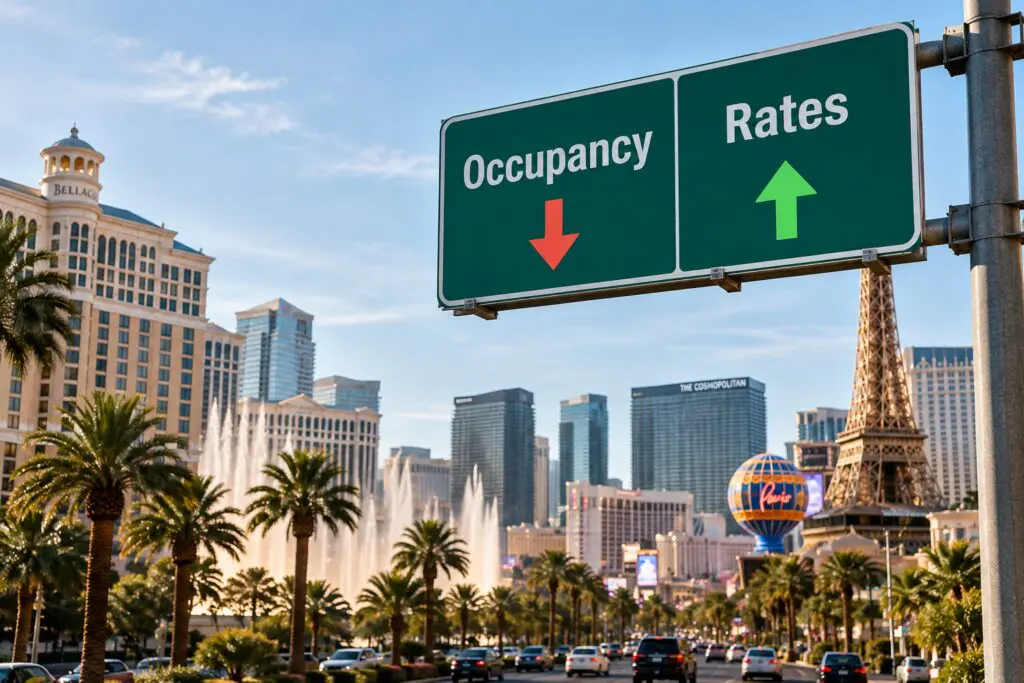
The lesson isn’t “hold your rate.” It’s “know why demand is there.”
If the takeaway from January were “occupancy drops don’t justify rate cuts,” June proves that rule wrong on its own. The actual difference between these months wasn’t occupancy. It was what kind of demand was filling the rooms.
January and May had something in common: compressed, high-value events with limited room supply competing for the same nights — CES and SHOT Show in January, a sold-out stadium tour and a 30th-anniversary festival in May. That kind of demand supports holding, even raising, rate. June’s convention surge was real, but broader and less concentrated, spread across a mix of trade shows without the same single-weekend compression — and it landed alongside a lighter concert calendar. Enough new demand to hold occupancy roughly flat, not enough scarcity to hold rate.
Neither a blanket “hold the line” rule nor a blanket “match occupancy” rule would have gotten all four months right. What would have: pricing that responds to the actual demand signal — event calendar, booking pace, how compressed the nights are — rather than a single lagging metric checked once a week.
Where this leaves independent hotels
Most independent properties aren’t in Las Vegas, and most don’t have a CES or an EDC filling their calendar. But the mechanism is the same at any size: a local wedding weekend, a college move-in rush, a regional sports tournament, or a slow stretch with nothing on the calendar all send different signals about how much pricing power you actually have right now — and none of those signals show up in an occupancy percentage by itself.
That’s the case for pricing that gets checked daily instead of weekly, and that responds to demand pace rather than a static rule someone set a month ago. See how a true daily rate compares to a once-a-week routine →
Where Ramsi fits
Ramsi doesn’t apply one rule — “hold” or “discount” — across every soft night. It reads demand pace, competitor movement, and local events daily and prices each night on its own signal, the same distinction Vegas’s own market made four different ways in four months. You keep the strategy and the guardrails. Ramsi keeps the read current.
FAQ
Should I raise my rate when occupancy drops, like Las Vegas did in January 2026? Only if the reason occupancy dropped is that fewer, higher-value guests are booking around a compressed event or limited-supply window. If demand is genuinely soft with nothing driving scarcity, holding or raising rate into a real drop in demand just costs you the booking.
Why did Las Vegas ADR fall in June 2026 even with a 26% jump in convention attendance? Convention attendance and pricing power aren’t the same thing. June’s growth was spread across a broader, less compressed trade-show calendar with a lighter concert schedule behind it — more room nights filled, but without the single-weekend scarcity that supports a rate increase.
What’s the actual takeaway for a small or independent hotel that isn’t in a convention market? The mechanism, not the market. Local demand spikes and lulls the same way Vegas’s convention calendar does — a wedding weekend, a tournament, a slow month — and what matters is reading which one you’re in, not applying one fixed rule to every soft or strong night.
How often should a hotel actually revisit its pricing based on demand shifts like this? Daily, not weekly. Monthly market data like Las Vegas’s shows the pattern after the fact; a property actually capturing it needs to see booking pace and local demand signals in closer to real time, since by the time a monthly report confirms a trend, the pricing window it applied to is already over.
Does automated pricing know the difference between a compressed, high-value event and a broad but low-intent demand surge? That distinction is exactly what daily, demand-driven pricing is built to catch, by watching booking pace and competitor movement as they happen rather than applying the same adjustment to every occupancy change. A system checked once a week can’t tell the two apart until after the window’s closed.
