Last updated: October 22, 2026
Short answer: Agentic AI means software that acts on its own — setting a goal, taking action, checking the result, and adjusting — instead of only answering when you ask. That’s different from a chatbot, and for a hotel evaluating software in 2026, it’s the difference that decides what you’re actually paying for.
“Agentic AI” shows up in almost every hotel tech pitch now, right next to “AI-powered” and “smart.” That’s made it easy to write off as a rebrand of the chatbot you already ignored. It isn’t. A chatbot answers a question when you ask it. An agent takes the next action on its own, without waiting to be asked. For an independent hotel evaluating software in 2026, that distinction decides what you’re actually paying for.
What Agentic AI Actually Means
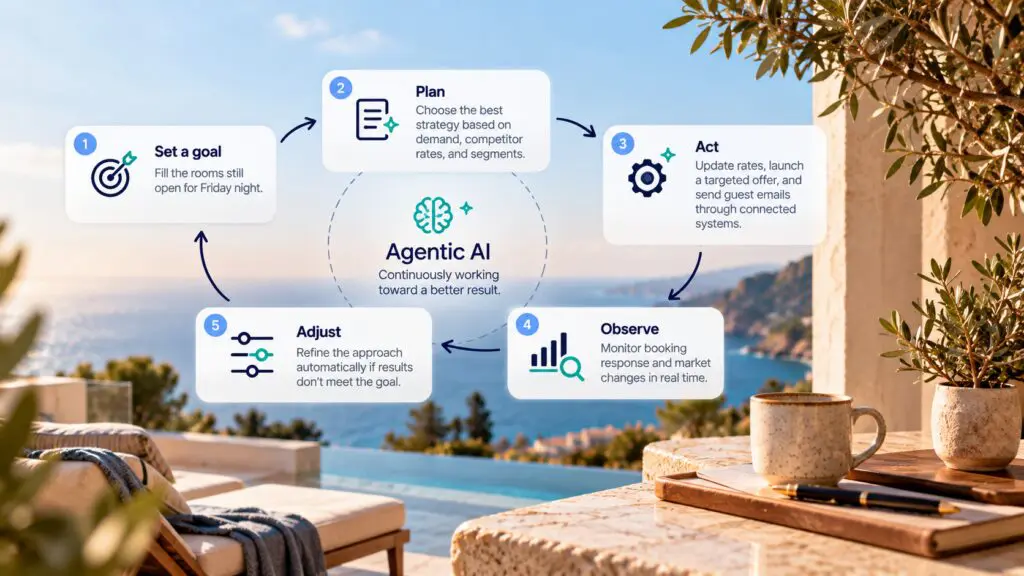
An agent works in a loop, cycling through five stages until a task is done: goal, plan, act, observe, adjust (SiteMinder). An operator sets a broad goal — fill the rooms still open for Friday night. The agent plans a strategy, such as a flash sale or a targeted email push, then acts on it through the systems it’s connected to: updating rates, launching the promotion, sending the emails. It observes whether bookings respond, and if they don’t, it adjusts the approach rather than waiting for someone to notice and intervene.
That loop runs inside guardrails, not unsupervised. A well-built agent operates within limits someone sets — a budget cap, an approved messaging tone, a maximum discount — the same way a capable junior manager works inside rules a GM sets, instead of free-styling. SiteMinder frames the broader distinction as a guidebook versus a concierge: generative AI is the guidebook, holding useful knowledge that only helps once someone acts on it, while agentic AI is the concierge that acts on the recommendation itself — making the booking, arranging the taxi, leaving the confirmation (SiteMinder). An agent is the concierge. It acts first and reports back, instead of waiting at the desk for a question.
Why 2026 Adoption Data Matters
Adoption is still early, and that’s worth knowing before a vendor implies otherwise. Just over 61% of travel businesses are experimenting with or already scaling agentic AI, but only 22% have moved past experimenting into real scaling, and a mere 6% describe themselves as actively scaling it (Phocuswright, “Budgets, Barriers and the Race to Agentic AI,” 2026).
Show Image
Hotel-side intent backs that up, even if execution lags. A 2026 survey of 400-plus hotel technology decision-makers found 71% see AI as having a significant or transformative impact on the industry, 85% expect to put at least 5% of their IT budget toward it, and 82% expect their organization’s AI use to increase within the year (Canary Technologies, “Navigating AI: Hospitality Shifts From Exploration to Execution,” via Hospitality Net). In other words, the appetite is well ahead of the deployment. That gap is exactly why the “is this really agentic, or just AI-branded” question matters right now — a lot of software will claim the label before it earns it.
Chatbot vs. Agentic: A Pricing Example
Picture a guest-facing chatbot and an agentic pricing tool handling the same piece of information: tonight’s room rate. Ask the chatbot, and it looks up the number and tells you. That’s useful, but it’s reactive — it only moves when someone prompts it.
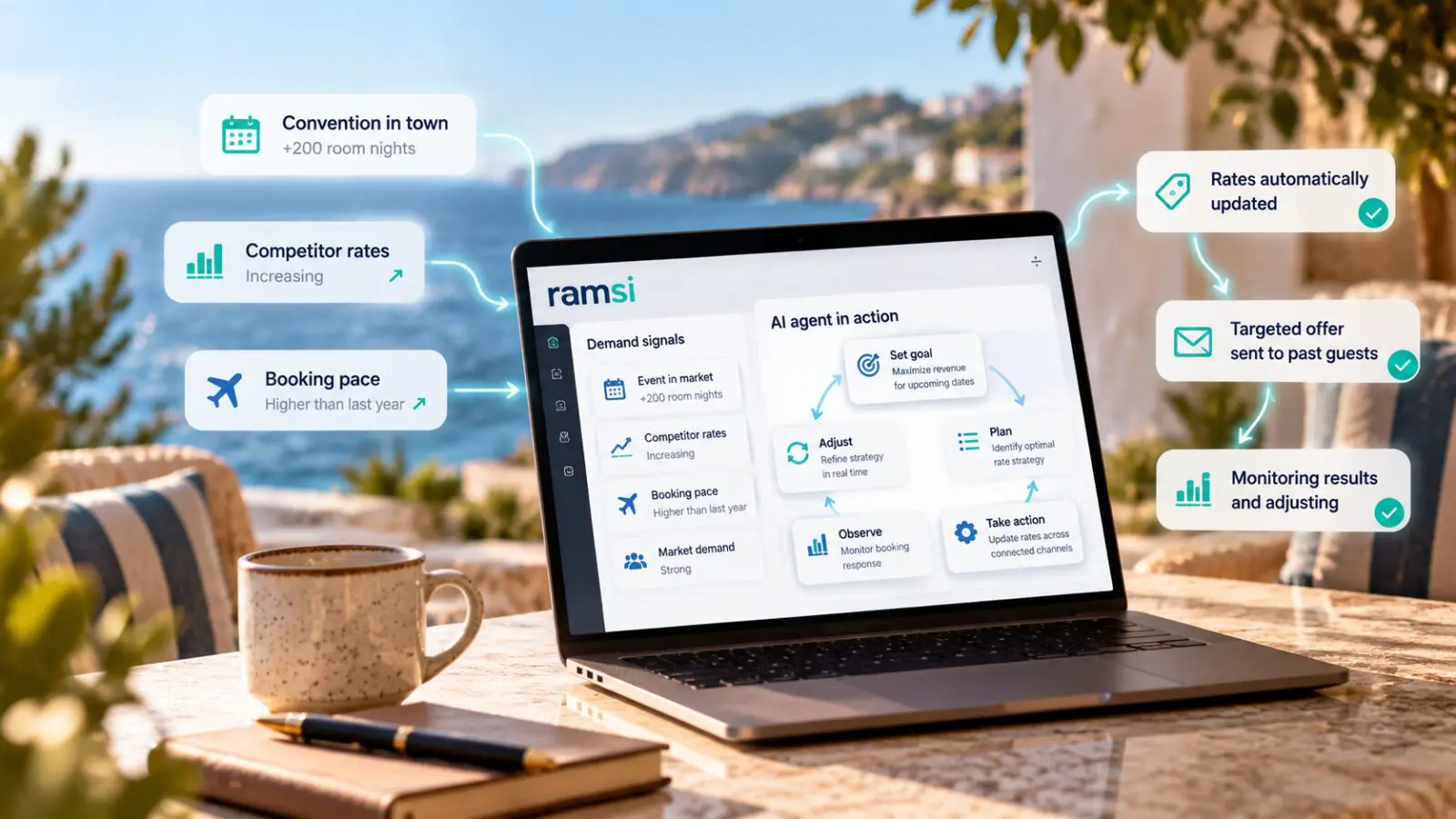
An agentic pricing tool skips the question entirely. It sees a convention just added 200 room-nights of demand to the market, checks what competitors are charging, raises your rate before you’d have thought to look, and logs the change for you to review later. Hospitality Net draws the same line industry-wide: an agent can “set goals, make decisions, and take actions independently, often across multiple steps,” where a chatbot only replies once asked (Hospitality Net). One waits at the desk. The other is already working.
What to Check Before You Trust an “Agentic AI” Claim
Not everything marketed as agentic actually works the loop described above. Before taking a vendor’s word for it, ask a few direct questions.
Does it act without a person triggering each step? If someone still has to log in and click “apply” for every change, that’s a recommendation engine wearing an agentic label, not an agent.
Can you see what it changed and why? A real agent should log its own decisions — what it adjusted, and what signal drove it — not just the output.
Does it operate inside limits you set? Guardrails are what separate an agent you can trust with pricing from one you have to babysit. If a vendor can’t describe its own limits, that’s worth a follow-up question.
Does it get better with more data, or just repeat the same rule? An agent that observes outcomes and adjusts behaves differently from a static rules engine wearing AI language.
Where Ramsi Fits
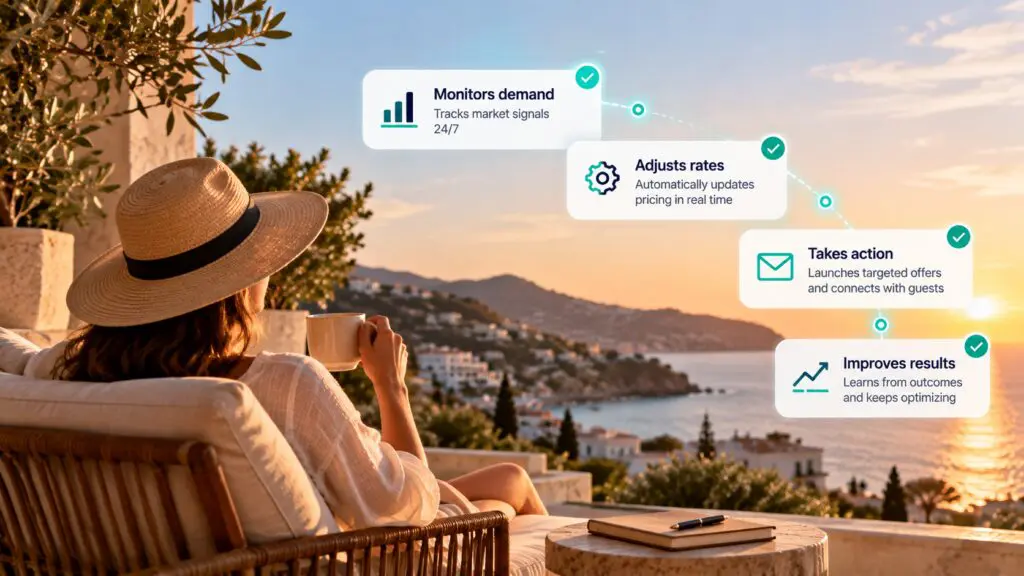
Ramsi runs that same loop, not a chat window. It watches demand signals, adjusts pricing, and reports back — it doesn’t wait for someone to log in and ask. That’s the core of Ramsi’s own positioning: agentic AI, not a chatbot bolted onto a dashboard. No dedicated revenue manager required, and no new routine to learn. See how that pairs with the system you already run →
FAQ
What does “agentic AI” actually mean for a hotel? It means software that takes pricing or operational action on its own — setting a goal, acting, checking the result, and adjusting — instead of waiting for someone to ask a question or approve each step.
Is agentic AI just a new name for a chatbot? No. A chatbot answers questions when prompted. An agent initiates actions on its own, within guardrails someone sets, and reports what it did.
How many hotels and travel businesses are actually using agentic AI in 2026? About 61% are experimenting with or already scaling it, but only 6% describe themselves as actively scaling it — adoption is real but still early for most.
How can I tell if a vendor’s “agentic AI” claim is accurate? Ask whether it acts without a person triggering each step, whether it logs what it changed and why, and whether it operates inside limits you set. If the answer to any of those is no, it’s closer to a recommendation tool than an agent.
Does agentic AI replace the need for a revenue manager? No. It replaces the manual, repetitive part of checking data and adjusting rates. Strategic judgment — what segments to target, how to handle an unusual event — still benefits from a person in the loop.
Is agentic AI safe to trust with pricing decisions unsupervised? A well-built agent isn’t unsupervised — it runs inside guardrails like rate floors, ceilings, and approval thresholds, and logs every change so you can review and override it.