Last updated: October 14, 2026
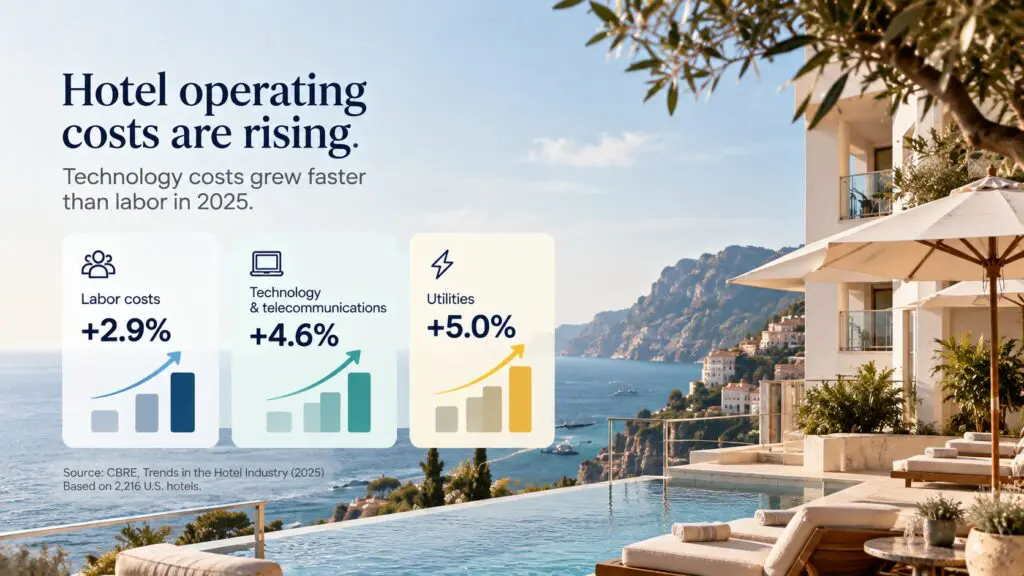
Here’s the assumption behind a lot of stalled software decisions: technology is the expense you can defer, and labor is the one you can’t. The 2025 numbers say otherwise. Hotel labor costs rose 2.9% per occupied room last year. Technology and telecommunications costs rose 4.6% — faster than labor, not slower (CBRE). So the real question for revenue management software ROI isn’t whether the spend is small. It’s whether that spend earns its keep.
The Math Behind the Question
CBRE’s Trends in the Hotel Industry report tracked 2,216 U.S. hotels and found operated department expenses up 2.9% overall, with hotel labor — over half of that spending — rising at the same 2.9% pace, per occupied room. Information and telecommunications costs climbed faster, at 4.6%. Utilities rose even more, at 5.0%. None of these categories are shrinking, and technology isn’t the cheap line item it once was.
That shift changes the calculation. A tool that used to look optional now competes directly with a budget line that’s already growing fast. Revenue management software ROI matters more in that environment, not less — because the alternative isn’t “spend nothing,” it’s “spend on labor instead, at a comparable or higher rate.”
Where the Payback Actually Shows Up
Hotels are already squeezing labor efficiency. Hours per occupied room fell 2.3% industry-wide in Q1 2026, and productivity gains offset some — but not all — of the wage growth (HotelData.com). Overtime still crept up in several frontline roles. That’s a team running close to its efficiency ceiling, not one with slack left to absorb more manual pricing work.
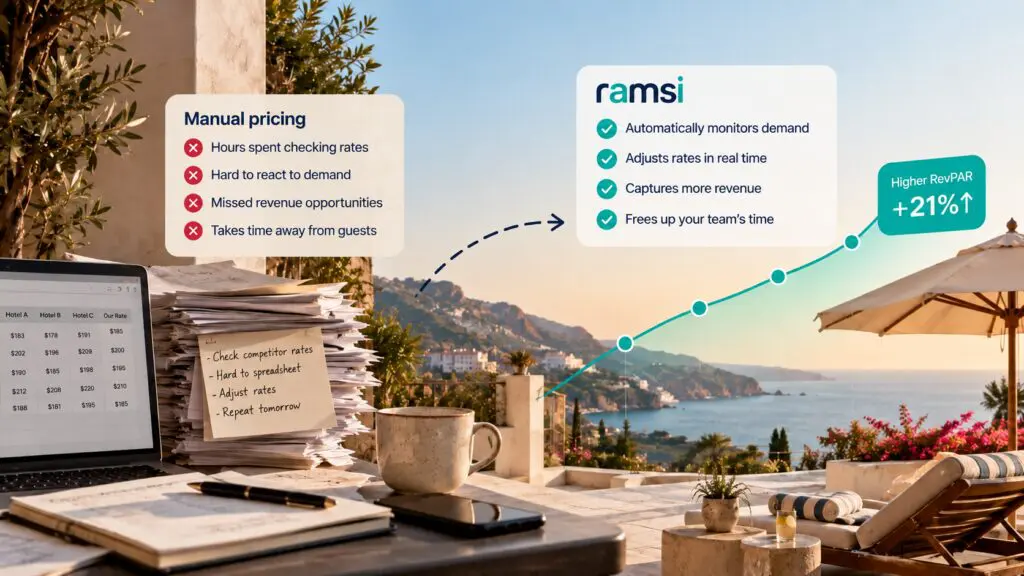
That’s exactly where revenue management software earns its cost back. Across a sample of 84 independent hotels, average RevPAR rose 21% after switching from manual to automated pricing (Hospitality Net). One general manager at the de Russie Boutique Hotel cut rate-management workload nearly in half after automating. A revenue manager at two properties went from two hours a day adjusting rates by hand to about one hour combined, automated, across both.
What That Means for a Small Team
None of this requires cutting staff to pay for a revenue management system. In fact, the opposite logic holds up better. Hand-checking competitor rates and updating spreadsheets used to take real labor hours. Once a system handles that work continuously, those hours go toward something else instead. The 21% RevPAR lift isn’t free money — it’s the gap between pricing someone checks once a day and pricing that responds in real time.
That gap is also why revenue management software ROI looks different for an independent hotel than it does for a chain. A chain’s revenue management department already prices continuously, so it has already absorbed that labor cost. An independent hotel without that department either pays for the labor hours directly, or it pays for software that does the same job without the headcount. Given that labor costs aren’t falling and technology costs are climbing too, the comparison isn’t “software versus free.” It’s software versus a manual process that’s getting more expensive to run either way. See how that pricing discipline plays out in practice →
Where Ramsi Fits
Ramsi runs the pricing work continuously instead of asking someone to check rates once a day between other jobs. It acts on demand data itself — no dashboard to babysit, no dedicated revenue manager required. That’s the actual case for revenue management software ROI. The tool isn’t cheap by itself — the manual alternative just costs more in labor hours than the software costs in fees.
FAQ
Does revenue management software actually pay for itself? Across a sample of 84 independent hotels, average RevPAR rose 21% after switching from manual to automated pricing. For most properties, that revenue lift outweighs the software’s cost within the first year.
Is technology really a bigger cost driver than labor for hotels right now? Yes, as of the most recent CBRE data. Technology and telecommunications costs rose 4.6% in 2025. Hotel labor rose only 2.9% per occupied room over the same period — a reversal of the usual assumption that labor grows fastest.
Will revenue management software replace staff or cut headcount? No. It replaces the manual task of checking competitor rates and updating prices by hand, not the strategic judgment behind pricing decisions. Staff hours shift toward work the software can’t do instead of disappearing.
How quickly does revenue management software typically pay back its cost? Case data from independent hotels shows measurable RevPAR gains within the first year of switching to automated pricing. Some properties cut rate-management workload by close to half almost immediately.
Do I need to already have high labor costs to benefit from revenue management software? No. The ROI comes from pricing accuracy and continuous repricing, not from labor cost levels specifically. A lean team benefits because it has less spare capacity to check rates manually in the first place.