Last updated: October 1, 2026
Here’s the assumption that keeps independent hotels out of this conversation: revenue management for small hotels is still priced and built like it’s for a chain with a department down the hall. That was true once. It isn’t anymore. In fact, the gap between “built for enterprise” and “built for a team of one or two” has closed faster than most independent owners have noticed.
What Revenue Management for Small Hotels Actually Does
A revenue management system prices your rooms. In short, that’s the whole job. It watches demand, competitor rates, booking pace, and local events. Then it adjusts what you charge, by room type, by night. It is not your property management system — instead, your PMS runs the front desk, the reservations, the housekeeping board. Because PMS and RMS solve different problems, a hotel can run an excellent PMS and still price every room by gut feel.
It’s also not a chatbot, and it’s not a dashboard that flags anomalies for someone to review later. A real system built for independent hotels acts on the data itself. For example, it adjusts a rate because a competitor just dropped theirs. It doesn’t wait for someone to open a report on Thursday.
The Independent Hotel’s Actual Problem
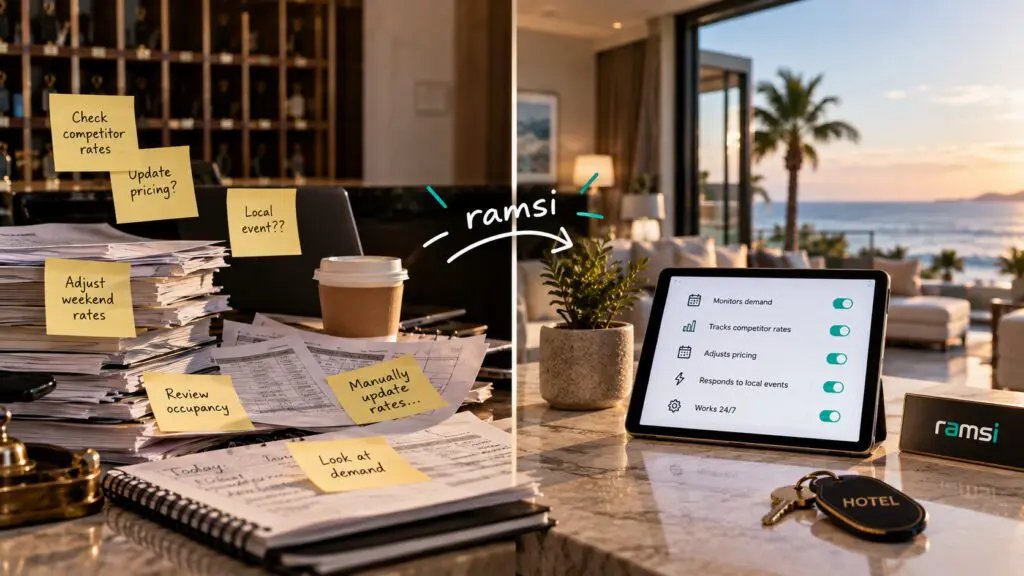
Large chains have revenue management departments because they can afford to. Most independent and boutique hotels can’t. Instead, one person handles pricing between check-ins, supplier calls, and whatever today’s fire is. That’s not a staffing failure — it’s just the math of running a smaller property.
Here’s the uncomfortable part: independent hotels arguably need good pricing discipline more than chains do, not less. A 20-room property with thin margins can’t absorb one underpriced weekend the way a 400-room flagged hotel can (LodgIQ). As a result, automating that pricing work gives teams back 20 to 40 hours a month. That’s time that used to go into spreadsheet updates and rate-shopping competitors by hand — now it goes into anything that actually grows the business.
What Actually Changed
The honest reason most small teams never adopted a revenue management system wasn’t that they didn’t see the value. Vendors simply priced the tools for someone else. Enterprise RMS platforms historically ran $30,000 to $50,000 to set up, because they were built for portfolios with dedicated analysts to run them.
Revenue management for small hotels looks different today. Setup now typically runs $7,000 to $10,000 to get live. Vendors price it by room count, not a flat enterprise fee. And they build the interface for a GM or owner to run alone, not an analyst (LodgIQ).
The technology moved too, not just the price. Today, 86% of hoteliers already lean on AI for forecasting and demand analytics. Properties using AI-driven pricing, as a result, report meaningfully higher total revenue than those still running static rules (Hotel Technology News). None of that ever needed a data science team to use. It just needed someone to build the tools for people who don’t have one.
What to Actually Look For
If you’re a small team evaluating a revenue management system, the enterprise checklist doesn’t apply. Still, a few things matter more than the rest.
No dedicated revenue manager needed. A system that requires daily interpretation from a trained analyst was built for enterprise. Someone just repackaged it and handed it to you.
It works alongside your PMS, not instead of it. Good revenue management for small hotels should connect to the property management system you already run. It shouldn’t ask you to replace it.
Transparent, room-count pricing. A flat enterprise fee is a red flag. Because of it, you can usually tell the vendor built the product for someone bigger than you.
A real implementation timeline, not a sales promise. Look for a phased rollout: monitoring first, then semi-automatic, then full automation, over roughly 8 to 12 weeks. That timeline tells you more about whether a vendor understands small teams than any feature list does (LodgIQ).
Where Ramsi Fits
Ramsi fits exactly that team: no dedicated revenue manager, no enterprise budget, no appetite for learning a new system on top of an already full day. It runs alongside your PMS and reads demand daily. Then it adjusts pricing itself, instead of surfacing a report and waiting for someone to act on it. See how that pairs with the system you already run →

FAQ
What’s the difference between a PMS and a revenue management system? A property management system runs your front desk, reservations, and housekeeping. A revenue management system prices your rooms. They solve different problems, and most hotels need both — just not the same tool doing both jobs.
Do I need a dedicated revenue manager to use a revenue management system? No. Revenue management for small hotels runs without one by design. The system handles daily pricing decisions. An owner or GM sets the strategy and the guardrails.
How much does a revenue management system cost for a small or independent hotel? Typical setup now runs $7,000 to $10,000. Vendors price it by room count, a sharp drop from the $30,000 to $50,000 enterprise platforms used to charge. Ongoing costs scale with property size, not a flat enterprise fee.
How long does it take to get a revenue management system live? Most small-team rollouts take roughly 8 to 12 weeks. They start in monitoring mode, move to semi-automatic, then shift to full automation — not a single switch-over on day one.
Is AI-driven revenue management actually accurate enough for a small property? Early resistance made sense when vendors built these tools for portfolios with data science teams behind them. That barrier is gone now. AI-driven forecasting runs meaningfully more accurate than the static, manually-set rules most small teams used before — and nobody on staff needs to interpret the model to trust it.
Will a revenue management system replace the judgment I already bring to pricing? No. It clears the manual work: checking competitor rates, updating spreadsheets, repricing room by room. That, in turn, frees up the time you’d spend on tactical execution. The calls that actually need a person — strategy, exceptions, judgment calls the system shouldn’t make alone — still land on you.